Saturday, April 10, 2010

Batanes: Around Mahatao, Ivana and Uyugan, Batanes


We did our usual afternoon trip around the southern part of Batan Island yesterday. That includes the towns of Mahatao, Ivana and Uyugan. One of my favorite heritage stops along the way is the Mahatao Church (dedicated to San Carlos Borromeo), which is a National Cultural Treasure.

I was pleasantly surprised to see an old lady wearing a vacul close to the church. For the longest time, seeing someone actually wear a vacul has eluded me in all my visits to Batanes until now. She was very gracious to the group for allowing everyone to take her photo and have their photo taken with her.


Our next stop was Ivana. Another popular stop is the House of Dakay (built in the maytuab style). Said to be the oldest stone house that is still in use in Batanes, it dates back to 1860. Its lone occupant, Florestida Estrella, is now 83.

Other stops in Ivana include Honesty Cafe and the Ivana Church. We were told that Ivana, Batanes is the smallest municipality in the entire country, both in population (1,181 in 2007) and land area (16.54 square kilometers). So unless anyone disputes that, I'll accept it as fact.


We then drove by Uyugan before proceeding back to Mahatao via the Racuh a Payaman (also known as Marloboro Country) where the group enjoyed the sunset. Racuh a Payaman means wide pasture. According to the Batanes Provincial Government, this communal pasture collectively managed by the townsfolk depicts a people that values community ownership over private property. It adds that the beauty of Racuh is as awe-inspiring as the concept that it represents: that collective management is best where land space is limited.

The skies were overcast when we arrived in the morning. But the sun thankfully came out later in the afternoon. But despite the sun, the weather was pleasantly cool. Indeed, it was a welcome relief from Manila's scorching hot weather!

Friday, April 09, 2010

Batanes: SEAIR flight to Basco, Batanes


I'm back in Batanes! We took the second SEAIR flight this morning. They have daily flights plus twice daily flights for certain days of the week. Skies here are overcast, not as sunny as I expected. But the result is very pleasant weather, a welcome relief from the heat of Manila!

We'll be going around Batan Island this afternoon. Anyway, for inquiries and reservations on SEAIR flights, call (02) 8490100 or book online at www.FlySeair.com. Join SEAIR Facebook Fan Page for updates on promos.

But if you still want to join our next Ultimate Batanes tour (the next April tour is already fully-booked), we have one last run from May 28 to 31, 2010. Just send an e-mail to reservations@ultimatephilippines.com. Slots are running out so book now!

Thursday, April 08, 2010

Quezon: Book now for the Ultimate Pahiyas and Quezon Culinary & Heritage tour!


Have you been to Quezon and its San Isidro Labrador festivals every May 15? It's fiesta time this month of May and what better way to drink, eat and be merry as we head south to explore charming Quezon province. It's the best time of the year as we join in the revelry and celebrate the feast of San Isidro de Labrador!

First off to Sariaya, a charming little town known for its gracious colonial-period homes. We'll have breakfast, take a stroll and admire these treasures as we revel in its traditional Agawan Festival.

Then, it's off to Lucban and the Pahiyas Festival where we'll feast our eyes over a smorgasbord of food, music, artistry and local color in one of country's most spectacular fiestas!

Finally, on to San Pablo, Laguna to dine at a restored period home, a great way to cap-off our Quezon experience!

You will discover the best way to experience the San Isidro Labrador festivals: Pahiyas in Lucban and Agawan in Sariaya, the charming heritage town of Sariaya as well as a lovely dinner at the artsy Sulyap Gallery Cafe and anything and everything about Quezon's Tagalog heritage with the best guide in town, Tina Decal!

Tour Fee is Php4,800 per person inclusive of breakfast, lunch and dinner, all entrance fees and demonstrations, tourist bus transportation, the best personal guide in Quezon (Tina Decal), plus surprises along the way.

For bookings, e-mail reservations@ultimatephilippines.com or contact my tokayo, Ivan ManDy (0917) 3291622.

Ilocos Norte & Ilocos Sur: Book now for the Ultimate Ilocos Culinary, Heritage & Beach Tour!


It's about time you experience the ABCs of the Ilocandia: antiques, bagnet and churches! In Ilocos, nature and history is intertwined. But at Ultimate Philippines, we think this is combo best savored with bagnet and beer so we're exploring this provincial belle... our style!

Let's journey up to the north and take a time-warp through the colonial city of Vigan. We'll walk through cobbles, munching our way through the town's traditional street fare and home-cooked feasts, from yummy empanadas to tasty longganisas.

More historical bites and pinakbet pizza as we take a peek at the life of ex-strongman Ferdinand Marcos in the town of Batac and admire two masterpieces of Ilocos' unique Earthquake Baroque architecture: Paoay and Santa Maria Church.

Capping off, we'll surf through the waves of Mairaira Beach in Pagudpud ending our journey in time to join the revelries of the annual Tres de Mayo fiesta in Vigan.

Tour Route will include the Sabangan Cove Weaving Village, Santa Maria Church and Paoay Church (UNESCO World Heritage Sites), Herencia Cafe, Marcos Mausoleum, Glory's Empanada, Cape Bojeador Lighthouse, Bangui Windmills, Blue Lagoon (Pagudpud), Saramsam Cafe, and Vigan (UNESCO World Heritage Site) and its Tres de Mayo Fiesta where we'll have feasts at an old house and garden restaurant and savor its street food in style!

Tour fee is Php15,000 per person inclusive of van transportation, overnight accommodation at the best resort in Pagudpud (Kapuluan Vista Resort) and at a very-private hotel at the heart of the heritage town of Vigan (My Vigan Home) and full board and all meals. We're only accepting a maximum of 20 people for this May 1 to May 3, 2010 tour. So book now!

For bookings e-mail reservations@ultimatephilippines.com or contact my tokayo, Ivan ManDy at (0917) 3291622. For posts about last year's tour, check out: Ilocos road trip, Mairaira Cove (Blue Lagoon), Ilocos culinary adventure and Tres de Mayo Festival.

Laguna: Heritage town of Pila, Laguna


Pila is the heritage town of Laguna. The historic center of the town was declared a National Historical Landmark by the National Historical Institute in 2000. It was known as La Noble Villa de Pila, one of the few towns in the country which was elevated to villa during the Spanish colonial period.


The center of town is an elegant collection of colorful colonial period structures located around a spacious plaza. The layout out of the town is very typical of most Spanish colonial towns. On one side of the plaza is the Pila Church dedicated to San Antonio de Padua. On the opposite end of the plaza is the charming Pila Municipal Hall dating back to the American colonial period and painted in brick red. And on the west and east sides are the elegant homes of the town's principalia.

Pila's house colors come in shades of brown, pastels and white. This was how houses were painted during the Spanish and American colonial periods. It was not all white.


The town has a very active heritage conservation group, the Pila Historical Society Foundation, Inc. which has continuously led efforts to preserve the heritage of this genteel town. Here's a map of historic structures in Pila, Laguna if you want a guide while you do a walking tour.

Tuesday, April 06, 2010

Pampanga: Easter Sunday salubong, pusu-puso and sagalas of Santo Tomas


On Easter Sunday, the neighboring towns of Santo Tomas and Minalin are the center of activities in Pampanga. Aside from being Easter Sunday, it's also the town fiesta of Santo Tomas. The town celebrates its fiesta on Easter Sunday rather than on the July 3 feast day of St. Thomas the Apostle.

The night before, a rigodon de honor used to be performed at the Sabado de Gloria Ball called the Thomasian. I remember dancing the rigodon in the 2002 Sabado de Gloria Ball. Sadly, they stopped doing it about two years ago because no one was willing to be hermano and hermana mayor due to the costs that accompany it. While it was still being held, Thomasian was the longest continuously organized rigodon de honor in Pampanga. The oldest surviving rigodon tradition in Pampanga, the El Circulo Fernandino, was not held from 1987 to 1996.


According to Robby Tantingco of the Center for Kapampangan Studies, "The most elaborate salubong are held in front of the churches of Sto. Tomas and Minalin. Shortly before the break of dawn, the brass band plays and an all-girls' choir sing Alleluia as the two santos are positioned face to face. The angel does not immediately appear; instead, she is hidden inside a pusu-pusu (heart-shaped giant banana flower) which opens in five stages, one layer of petals at a time. Each opening is accompanied by the band playing and choir singing which prolongs the whole ceremony. After the salubung (also called pusu-pusuan in these parts), the people go inside the church for the Easter Mass.

"In Sto. Tomas, another quaint tradition follows after the Mass: a group of well-dressed girls and the partners dance and sing, and throw petals on the path of the carroza bearing the statue of the Risen Christ accompanied by a violin. This ritual is called Sagalas."


Later at noon, the Pakbung Hudas festivities are held at the church patio. I missed the Salubong or Pusu-pusuan, as well as the Sagalas. But I just had to write about it to complete this series on Pampanga Holy Week practices. Thank you to the Center for Kapampangan Studies for the video screencaps.

Pampanga: Santo Entierro carrozas and Good Friday processions of Pampanga


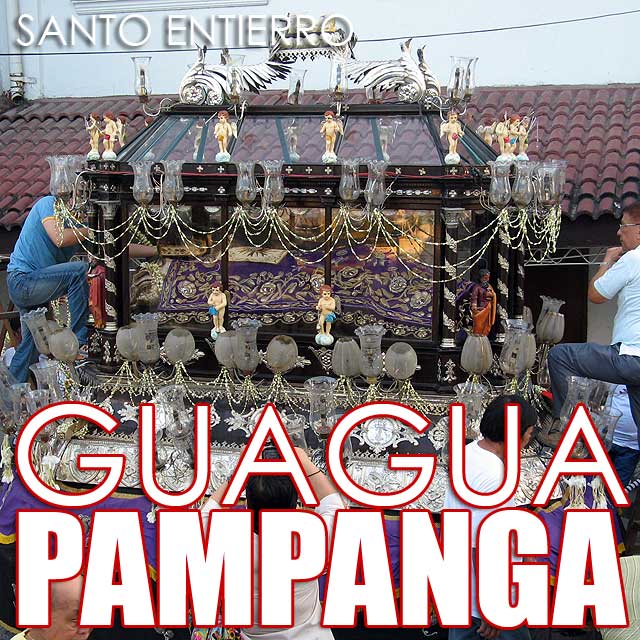
Every Good Friday, the Santo Entierro or Apung Mamacalulu are brought out in grand carrozas called calandras for the Good Friday procession. Here are photos of some of the Santo Entierro carrozas or calandras of Pampanga. It's a work in progress so I'll be adding photos and descriptions as I receive them. Thanks to the Center for Kapampangan Studies for providing some of the photos including this one of the Guagua carroza being prepared for the Good Friday procession.

ANGELES: Alex Castro shares that Angeles has its own Apung Mamacalulu or Santo Entierro owned by the Dayrit clan. This image figured in a controversial 1929 Good Friday procession that ended in its kidnapping. It took a Supreme Court decision to resolve the issue of its ownership.

ARAYAT: According to Toto Gonzalez, the Arayat Good Friday procession is lovely and beguiling with antique candlelit carrozas and old, archaic-sounding Kapampangan religious music. A burol or wake for the Santo Entierro commences after the procession at the Spanish colonial era chapel of the Medina-Samia-Santos family a few meters from the church. This last until 11:30 p.m.


BACOLOR: The Bacolor Santo Entierro is owned by the Joven-de Leon clan. It most probably had belonged to Don Juan Joven and Dona Geronima Suares. It was buried by lahar in 1995 and was dug up the same year. It was kept until 2004 when it was restored by Tom Joven who is now the caretaker of the image.

GUAGUA: The Guagua Santo Entierro in the main photo is owned by the Infante-Velez clan.


MABALACAT: The Apung Mamacalulu of Mabalacat has its own chapel beside the Mabalacat Elementary School. It is believed that the image originated from Mexico. It belonged to Doña Vicenta Dizon who was married to Don Juan Rivera. The couple were childless so the calandra was passed on to the Rivera-Serrano family. Preparing the image for the procession is a community affair, done during the morning of Holy Thursday. The carroza is ornamented by mother of pearl flowers and silver symbols of the passion of Christ.


SAN FERNANDO: Above is the Santo Entierro of San Fernando. This is a fairly recent postwar calandra.


SANTA RITA: The Santa Rita Santo Entierro is owned by the Miranda-Maglalang clan.


SASMUAN: The Sasmuan Santo Entierro is owned by the Mercado family.

According to Toto Gonzalez, the five most beautiful calandras of the Santo Entierro in Pampanga are Santa Rita (Miranda-Maglalang), Arayat (Medina-Samia-Santos), Sasmuan (Mercado), Guagua (Infante-Velez), and in recent years, with all the improvements made by the formidable Tom Joven, that of Bacolor (Joven-de Leon). He adds that also beautiful, although simple, are the mid-1800s calandras of San Luis, Minalin, Santa Ana, Mexico, Mabalacat, Candaba, and Apalit. Those of Lubao, Magalang, Angeles date back to the turn of the 20th century. The calandras of San Fernando and Macabebe are fairly recent. He hasn't seen those of Masantol, Porac, and Floridablanca though and we look forward to his reviews. While many of the calandras date from the 1800s, many of the images of the Santo Entierro are from the 1700s.

Toto further notes that the only existing calandras in other provinces that can compare with those of Pampanga are: Vigan, Ilocos Sur; Lingayen, Pangasinan; Baliuag, Malolos and Barasoain, Bulacan; San Pablo (originally from Santa Cruz, Manila), Binan, Pila, Paete, and Pakil, Laguna; Lipa, Batangas; Carcar, Cebu; Molo, Iloilo City; Bacolod and Talisay, Negros Occidental and Mambajao, Camiguin.

If you have photos or stories of other Santo Entierro carrozas in Pampanga, please feel free to share them at info@ivanhenares.com.

Monday, April 05, 2010

Pampanga: Pasyon Serenata in (Maligaya) San Basilio, Santa Rita, Pampanga


After the Good Friday processions, we returned to San Basilio, Sta. Rita, Pampanga to listen to the Pasyon Serenata. But this time, we proceeded to Maligaya Street which is also in San Basilio, which has its own Pasyon Serenata.

As I mentioned previously, the Pasyon Serenata is a variant of the pabasa, with two sets of accompanying singers and marching bands playing alternately in what is called a sagutan. It's held in the evenings (usually 8 p.m. to 12 midnight) of Holy Thursday and Good Friday in two locations in Barangay San Basilio, Sta. Rita, Pampanga. The previous night, we watched the one beside the San Basilio Chapel.


Parking and maneuvering is a bit difficult in Maligaya since the street is very narrow. Anyway, we sat down for quite a bit but suddenly felt the exhaustion from all the traveling. So we called it a night quite early.

Sunday, April 04, 2010

Pampanga: Easter Sunday Pakbung Hudas tradition in Minalin & Santo Tomas, Pampanga


Firecrackers on Easter Sunday! In the towns of Minalin and Sto. Tomas, the Pakbung Hudas (explosion of Judas) tradition is still held every Easter Sunday. We drove to Minalin to catch the Pakbung Hudas festivities at 9:30 a.m. and proceeded to Sto. Tomas to catch theirs at 12 noon.


Pakbung Hudas is an event wherein an effigy of Judas Iscariot, stuffed with firecrackers, is lit up in front of the church patio for a big bang to start the Easter Season. The firecrackers are so positioned so that the effigy moves horizontally counter-clockwise then clockwise, then vertically clockwise and counter-clockwise before finally exploding.

For some reason, they want to change the name to Pakbung Kasalanan or Pakbung Satanas with the effigy representing sin or  in particular, the seven deadly sins. But I think changing the name will change the story behind the tradition. You could still say Pakbung Hudas and explain that the effigy represents sin. Oh well!


I liked the Judas effigy in Minalin which was very colorful and folksy. The one in Sto. Tomas wasn't decorated though.


Since Easter Sunday is also the town fiesta of Santo Tomas, there are a lot of activities during the day. After the Easter Mass in the morning, sagalas paraded around town. They also had a palaro for the children. The agawan buko was quite intense!


Anyway, it took them quite a while to set-up the effigy which they lit up at about 12:30 p.m. Indeed they celebrate Easter in Pampanga with a big bang!

Pampanga: Salubong procession on Easter Sunday and the colorful pusu-puso


The Salubong is a Filipino tradition done early in the morning of Easter Sunday, wherein the images of the Risen Christ and Sorrowful Mother symbolically meet in a pre-dawn procession. While many parishes have moved it to late Saturday night for convenience, the real traditional Salubong happens right before dawn.


I was actually wondering if the pusu-puso was still being used in Pampanga. I should have asked. Anyway, I watched the Salubong in San Fernando late Saturday night which was quite simple.


The Bacolor salubong or pusu-pusuan was also at midnight and they used the pusu-puso! The photo above is from Tom Joven.


The next morning, I proceeded to Minalin and Santo Tomas to witness the Pakbung Hudas Easter Sunday festivities. And lo and behold, the opened pusu-puso were hanging from the church gates! The Salubong in Minalin was at 4 a.m. while the one in Santo Tomas was at 5:30 a.m.

The puso-puso is a fine example of folk art used for the Salubong. It's basically shaped like a bud with several layers of petals made out of cardboard, papel de hapon and crepe paper. Hidden above the pusu-puso is a little girl dressed as an angel. The veiled image of the Sorrowful Mother is brought under the pusu-puso.


Layer by layer, the pusu-puso opens, raining petals and confetti on the images of the Mater Dolorosa and Risen Christ. With the opening of the last layer, doves fly out and the little girl, who sings Regina caeli, laetare, alleluia (Queen of Heaven, rejoice, alleluia), is lowered on a swing just right over the head of the Mater Dolorosa so she could take off the veil. Once the veil is removed, fireworks are lit, the marching band starts playing and the crowd applauds. The Easter Season has begun.
Related Posts with Thumbnails