Saturday, November 28, 2009

Malaysia: Malacca's Perenakan (Nyonya) cuisine

Malacca also has it's share of Perenakan cuisine. So before I move on to a different topic, let's continue our discussion on Malaysian food. While we were in Malacca, we had lunch at a Nyonya restaurant called Seroni Nyonya Cuisine Restaurant.

We were served a really sumptuous selection of Nyonya cuisine that included chicken tempra, fish fillet with tamarind sauce, anchovies with cili garam, ginger venison (deer), fried kampung rice, lemak prawns and stir fried okra. For dessert, we were given yummy bowls of cendol.

While we did our walking tour around Jonker Street later in the afternoon, I also got to try out some of the goodies. There was a shop which sold pastries with pineapple filling as well as winter melon cakes (a.k.a. hopia). Along the street were a good number of hawker stalls which sold siomai, baked siew pau, radish and yam cakes, dried fish and squid, and other local stuff.

It's sad that the chicken rice balls restaurant was closed by the time we arrived. It's really in-demand so it gets sold out easily and they close shortly after lunch. In Malacca, Hainanese chicken rice was modified so that the chicken is served with rice balls rather than a bowl of rice.

Part 1: Melaka, Malaysia is a historic city of the Straits of Malacca

Related entries
More Straits Settlements history in Malacca

Exploring the Penang heritage trail on foot
Bus trip from Kuala Lumpur to Penang, Malaysia
Following the heritage trail in Penang

Seroni Nyonya Cuisine Restaurant

60 & 62 Taman Melaka Raja 1, Jalan Melaka Raya 24, Melaka
Telephone: +60 (6) 2814848

Friday, November 27, 2009

Malaysia: Traditional trades and food adventure in George Town, Penang

Intangible heritage, particularly traditional trades and local cuisine, is very much a part of the Penang cultural landscape.

I was quite pleased that some of these trades were identified in Penang maps. I got to see several of them while walking around old Penang such as the Chinese calligrapher and seal engraver who carves personal chops to order.

I also got to pass by the Nyonya beaded shoe maker who crafts women's shoes with beadwork faces. The designs are very colorful and intricate and I found out it takes several weeks just to complete a pair.

Near the Goddess of Mercy Temple is a joss stick maker who rolls incense and sandalwood sticks by hand. Also near the temple are several garland makers who create colorful flower garlands which Hindus adorn on statues of their deities.

Other trades worth seeing in Penang include the Indian goldsmith who hand tools gold jewelry in traditional Indian designs, the signboard engraver who carves and gilds Chinese calligraphic plaques, the songkok maker who sews Muslim headgear on an old fashioned sewing machine, and the tombstone engraver who chisels Chinese and Muslim gravestones by hand.

Penang is also a culinary delight. Another testament to its multicultural setting, you can get the best of Penang food from road-side hawker stalls. It's such a shame I missed trying out the Penang laksa, a spicy and sour tamarind-based fish soup with thick round rice noodles.

One of the more popular hawker areas is actually several kilometers outside old George Town in an area called Gurney Drive. The choices there are endless and it's a must visit for any serious foodie.

But inside George Town, you won't go wrong as well since hawkers set up shop, especially as day gives way to night. Anyway, while walking around George Town, I'd stop to taste something that looked interesting. Since I was on the go, I had cha shar pau and roti babi which I saw at Pitt Street Koay Teow Th'ng to satisfy my hunger.

The colorful Indian sweets got me really curious as well. But I would later realize they were like sweeter versions of our already sweet pastillas candies.

In the evening, I tried out the local satay as well as several noodle dishes such as wan tan mee and sui kau. I didn't want to eat too much. So I was content with walking around and observing all the hawkers cook their signature dishes.

Part 1: Bus trip from Kuala Lumpur to Penang, Malaysia
Part 2: Exploring the Penang heritage trail on foot

Related entries
Following the heritage trail in Penang
Melaka, Malaysia is a historic city of the Straits of Malacca
More Straits Settlements history in Malacca

Thursday, November 26, 2009

Malaysia: George Town and Penang's British colonial heritage

The cities of the Straits Settlements represent various periods in Malaysia's history. Melaka covers the period from the 15th century Malay sultanate to the Portuguese and Dutch periods beginning in the early 16th century. George Town on the other hand is a testament to the British era from the end of the 18th century.

Near St. George's Church and the Church of the Assumption and close to the sea are an ensemble of structures that remind us that George Town was once a British city. In between the two churches is the Penang State Museum. Built in 1906, it was once the home of the Penang Free School and the Hutchings School. Across the street is the Supreme Court Building built in 1905.

My personal favorite is the magnificently-white City Hall Building, a neo-Palladian building completed in 1903 to serve as the seat of government of Penang. Right beside it is the Town Hall Building which was completed in 1880.

Right beside these buildings is the Penang War Memorial. This cenotaph to commemorate war dead is something I've seen in many British colonial cities.

Like many colonial cities, George Town also has fortifications. Fort Cornwallis was built by Sir Francis Light immediately after his landing on the island, with its present star-shaped structure completed in the early 19th century. Beside it is the Queen Victoria Diamond Jubilee Clocktower built in 1902.

Facing the port in Pengkalan Weld (Weld Quay) are the Boustead and German merchant houses that were built between 1890 to 1910. The Customs Building with clocktower, built in 1907, once housed the F.M.S. Railways. Near Convent Light Street is the Eastern & Oriental Hotel, a grand colonial hotel established in 1885 by Armenian hoteliers. Check out the 1920s echo dome and Otis cage elevator. It's now a luxury all-suites heritage hotel.

Finally, a Christian Cemetery that dates back to 1790 still exists. It has both Protestant and Catholic sections and is the final resting place of many of Penang's governors, administrators and other pioneers.

Part 1: Bus trip from Kuala Lumpur to Penang, Malaysia
Part 2: Exploring the Penang heritage trail on foot

Related entries
Following the heritage trail in Penang
Melaka, Malaysia is a historic city of the Straits of Malacca
More Straits Settlements history in Malacca

Wednesday, November 25, 2009

Malaysia: Penang's ancestral temples, clan associations & mansions

Penang has a large ensemble of ancestral temples, clan associations or halls called kongsi, and grand mansions.

Kongsi are organizations among overseas Chinese communities for individuals with the same surname. Khoo, Cheah, Yeoh, Lim and Tan Kongsi were known as the Five Big Clans (or Goh Tai Seh) that formed the backbone of the Hokkien community of Penang. There are several more clan halls in Penang. But those worth visiting are the Khoo, Cheah and Yap Kongsi.

Khoo Kongsi is the most popular of Penang's Hokkien clan houses perpetuating Confucian practices and one of the most ornate clan halls outside mainland China. Established in 1835, the present temple was built from 1894 to 1906.

Cheah Kongsi is a Hokkien clan hall founded in 1820 and built in 1858. While Yap Kongsi was built in 1924 in the Straits Ecclectic style. It's Ciji Temple is a Taoist temple dedicated to Nan'an patron deity.

There are also ancstral temples such as the Han Jiang Ancestral Temple (or the Teochew Temple) which was built in 1870. The temple won the prestigious UNESCO Asia-Pacific Heritage Award in 2006 for outstanding restoration. Along King Street (Lebuh King) are temples which represent the diversity of the Chinese communities in Penang such as the Cantonese and the Hakka.

The Hock Teik Cheng Sin Temple is a temple to Tua Pek Kong (a Malaysian Chinese god) and was used in the mid-19th century as a Hokkien secret society headquarters.

Penang also has a great number of mansions in various architectural styles. The Cheong Fatt Tze Mansion is an example of the fusion between Oriental and Western architecture. It won the UNESCO Asia-Pacific Heritage Award in 2000. Also check out the residence of Ku Din Ku Meh and Syed Alatas Mansion (now the Islamic Museum).

The Pinang Perenakan Mansion is one of the most ornate private homes in Penang. Once the home of Kapitan Chung Keng Kwee, it now houses a museum of antiques from the Perenakan (Baba-Nyonya) community.

Along the historic neighborhood of Lebuh Armenia, although not a mansion, is Dr. Sun Yat Sen's Penang base.

Part 1: Bus trip from Kuala Lumpur to Penang, Malaysia
Part 2: Exploring the Penang heritage trail on foot

Related entries
Following the heritage trail in Penang
Melaka, Malaysia is a historic city of the Straits of Malacca
More Straits Settlements history in Malacca

Tuesday, November 24, 2009

Malaysia: Exploring the Penang heritage trail on foot

George Town in Penang is a living testament to the multicultural heritage of Asia as well as European colonial influences. As I stood in front of the Buddhist Goddess of Mercy Temple, I noticed a small Hindu shrine and stalls of garland makers. Just a few meters away was a joss stick maker. Down the same street as the temple is the Anglican St. George's Church. As I walked towards the church, a call to prayer echoed from the minaret of a centuries-old mosque.

There are several ways to experience old Penang. I’ve tried out the trishaw with the driver serving as your guide. But to me, the best way to explore and appreciate the rich cultural heritage of Penang is on foot.

As soon as I found a place to stay for the night and dropped my bags, I was off. Before you start, make sure you have a street map of George Town. There is a really good free map published by Areca Books which not only marks important architectural landmarks, but also some recommended food outlets, local crafts and trades, and places to shop for things that are uniquely Penang.

I tried to cover as much ground as I could given that I only had a day in Penang. But what is very obvious and commendable is that Penang's heritage has undergone a lot of restoration especially after its inscription in the UNESCO World Heritage List last year.

Among the sites I got to visit were religious structures of various faiths. There's the Goddess of Mercy Temple (Buddhist & Taoist) which is Penang's foremost Chinese temple established in 1800; and the Sri Maha Mariamman Temple (Hindu) consecrated in 1833.

St. George's Church built in 1818 is Southeast Asia's first Anglican church. While the Church of the Assumption (Catholic) dates back to 1787. The current structure was built in 1860 and was elevated to a Cathedral in 1955.

Nagore Shrine is a Tamil Muslim shrine to the Saint of Nagore. While the Kapitan Keling Mosque (also Tamil Muslim) was founded in 1801. The Malay Mosque in Lebuh Aceh was founded in 1808.

Part 1: Bus trip from Kuala Lumpur to Penang, Malaysia

Related entries
Following the heritage trail in Penang
Melaka, Malaysia is a historic city of the Straits of Malacca
More Straits Settlements history in Malacca

Banana Guest House
355/357/359 Chulia Street
+60 4 2626171
info@banananewguesthouse.com

Monday, November 23, 2009

Negros Occidental: Road trip from Himamaylan to Victorias

Negros Occidental is one province I haven't really explored. Except that trip to Mambucal when I was still a kid, and a more recent visit to Silay City some years back, I've only really been to Bacolod City. So I decided to explore Negros Occidental before our family reunion in Bacolod.

Since I only had a few hours after the welcome breakfast prepared by our relatives, I decided to rent a car to speed up things. We drove down south as far as Himamaylan and made our way north to look for some interesting stuff. Along the National Highway was this continuous stream of sugar cane trucks. Negros is one big sugar plantation and all you see on both sides of the road is sugar cane.

The first old church we passed by was Binalbagan Church built in 1937. Except for the retablo, most of the church has been renovated. And it was such a hassle to get to it no thanks to a presidential visit. I was shocked that they stopped traffic on the National Highway just to let her convoy pass. So we had to make a lot of detours. In fact, she arrived in town exactly when I was standing in front of the church.

Anyway, from Binalbagan, we went to the next town which is Hinigaran. The Hinigaran Church, completed in 1858, is one of the best-preserved Spanish colonial churches in Negros Occidental. I was quite impressed with its well-preserved exterior. But inside was a different story.

While most of the interior was intact, I was surprised that they were doing some renovations, trying to mimic some European church since they had a large tarpaulin of a church interior they were trying to imitate. These priests really need to realize that our churches are not European! They are Philippine Baroque to be exact, a folksy style only found in the Philippines. Let's keep our churches Filipino please!

Hinigaran is a favorite stop as well thanks to Mila's royal bibingka which you could buy from Mila's Restaurant along the National Highway. Another favorite is the creamy buko pie which is quite different from the ones in Laguna and the rest of the Southern Tagalog since they really put in a lot of cream.

While we were having lunch at Mila's Restaurant, the presidential convoy passed by again. And there she was in a coaster with windows open, waving to everyone like a queen.

From there, we proceeded to Valladolid. The Valladolid Church is also of Spanish colonial vintage. It was twin bell towers. But just like many of our heritage churches, the interior has been modernized.

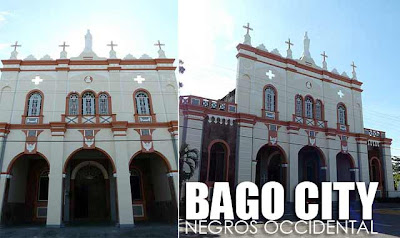
Bago City still has a few of its grand old mansions. One of those homes is the Gen. Juan Anacleto Araneta Mansion which is a National Historical Landmark. The grand ancestral house is now home to the local museum.

The Bago Church has a very unusual Neo-Gothic facade, built by the Augustinian Recollects in 1891. But again, the interiors have been modernized. The city plaza was the site of the historic proclamation of the Republica de Negros on November 5, 1898. This event is commemorated annually with the Al Cinco de Noviembre.

From Bago, we crossed Bacolod to get to Talisay City. There are two houses worth visiting there. One is the Lizares Mansion or the Balay ni Tana Dicang which is now a beautiful period museum and art gallery.

The other is the ruins of the grand mansion of Don Mariano Ledesma Lacson which is simply known as The Ruins. They have a restaurant there as well so if you like to have lunch or dinner amidst its old walls, that would be a great option. It's actually hard to get to and the roads are a bit bad. But see what proper conservation and marketing can do to promote the shell of an old house?

Anyway, since it was getting dark, I skipped Silay as well. Besides, you need a full day to explore this wonderful heritage city. And I've done it before. I'll try to visit Silay again when I get back.

Our last stop for the day was the Chapel of the Angry Christ inside the compound of the Victorias Milling Corporation. Did you know that the UP Chapel was originally designed for the Ossorio family? But I guess it doesn't matter now since the current chapel is itself a work of art.

The central figure of the vibrant altar murals is an image of Christ with a burning heart, standing on skulls and a serpent. It's that image from which the chapel gets its moniker since the church is actually dedicated to St. Joseph the Worker. These murals were painted by Alfonso Ossorio. Around the church are mosaics that were made using broken soda bottles.

I rushed back to Talisay City to attend an event at Balay ni Tana Dicang. But I decided to take that photo of The Ruins before it got really dark.

Sunday, November 22, 2009

Negros Occidental: MassKara Festival 2009 in Bacolod City

MassKara Festival in Bacolod City, Negros Occidental is one of the best festivals in the Philippines. My father's side is from Bacolod. But I've never been able to watch it until this year thanks to a family reunion that was purposely coincided with the MassKara Festival.

The MassKara Festival was first staged in Bacolod City in 1980. It's been held annually during the weekend closest to October 19, which is the Charter Day of Bacolod City. So this year marks the 30th time that the festival is staged.

The street parade is held along Araneta Street and makes its way to the Bacolod Public Plaza. Good thing it is walking distance from our house. There was a Schools Category held on October 17. But we weren't able to watch that since that was the day of our family reunion.

But we did get to watch the Open Category right before we flew out of Bacolod City on October 18. Although a street dance parade like many festivals in the country, the MassKara Festival is very unique because of the intricate masks that accompany the colorful costumes. I was able to see the dancers up close and indeed, the effort put into creating the festival masks is astounding and commendable.

I particularly liked the masks of Barangay Mandalagan. Their colorful masks looked very elegant and neatly-done. It's a good thing they won the Best in Mask Award.

After the parade, there was still a dance competition in the Bacolod Public Plaza. But since we had a flight to catch, so I was content with watching the competition and awarding on TV while waiting at the airport. I would have wanted to stay longer. But contrary to popular notion, traveling and blogging aren't the only things I've got on my plate.

Congratulations to Barangay Taculing, the champions of MassKara Festival 2009! Same goes to the runners-up Barangays Mandalagan and 23!

Wednesday, November 18, 2009

NPVB unveils its first tourism directional sign in North Philippines

Brown is the internationally-recognized color for tourism directional road signs. It's really a pity that our tourism signs in the Philippines are either blue or green. But the North Philippines Visitors Bureau (NPVB) will be correcting that error by installing several hundred brown tourism direction road signs in North Philippines.

Last November 17, 2009, the NPVB unveiled along the Jose Abad Santos Avenue (formerly Gapan-Olongapo Road) in the City of San Fernando, Pampanga, the first of several hundred tourism directional road signs. Leading the unveiling was Hon. Lorelei C. Fajardo (Deputy Presidential Spokesperson), local officials led by Pampanga Governor Eddie T. Panlilio, officials of the Department of Tourism, Department of Public Works and Highways, and the North Philippines Visitors Bureau, its network of local Conventions and Visitors Bureaus and its Corporate Partners.

The installation of these brown tourism markers along major thoroughfares in North Philippines is being undertaken as part of NPVB's effort to improve the tourists’ travel experience to its regions, where most tourist destinations are reached via land travel.

Two hundred fifty of these markers will be erected all over North Philippines, which are being made possible through the participation of SMART Communications, Robinson's, McDonald's, and Victory Liner.

NPVB is a private sector led, not-for-profit, membership-based organization with the mandate of promoting tourism in the regions of North Philippines. Currently, NPVB has a network of nine (9) local Convention and Visitors Bureaus (CVBs) in Pampanga, Greater Clark, Greater Subic Bay, Tarlac, Pangasinan, La Union, Baguio, Ilocos Norte and Cagayan. The network was set-up by MNTC as part of its on-going CSR effort. In 2008, management of NPVB was transferred to ActivAsia Inc. – a 360 degree, brand activation Company.

Under ActivAsia’s management, NPVB published the first-ever regional tourism magazine called Northbound Magazine. Now, NPVB proudly rolls out its latest project – the tourism directional road signs.

Vince Araneta, ActivAsia’s Director for Tourism Marketing and concurrently Executive Director of NPVB said, “This project is not the work of one, but the work of many - MNTC, Smart, McDonald’s, Robinson’s Land, DOT, DPWH and even SBMA – these markers are a result of the partnership and cooperation of all these parties. What began with the brown markers along the NLEX and DOT Usec. Oscar Palabyab’s dream of having the markers outside the NLEX as well, is now happening. ActivAsia’s role, was simply to make the dream a reality.”

Friday, November 13, 2009

Batanes: Book now for the 2010 Ultimate Batanes Culinary and Heritage Tours!

Ultimate Philippines Tours announces its Batanes schedule for 2010. We're posting our tour dates early for the benefit of those who want to plan their trips way in advance, especially the balikbayans.

Tours leave Manila early morning Friday and arrive back mid-morning Monday. We have six dates to choose from: (1) March 6 to 9, (2) March 20 to 23, (3) April 9 to 12, (4) April 30 to May 3, (5) May 14 to 17 and (6) May 28 to 31.

The tour fee is Php34,000 all-in, which includes the round-trip SEAIR Manila-Basco flight, accommodation at Fundacion Pacita, all meals, activities and transportation in Batanes. Due to increases in rates of accommodation for next year, we had to increase our tour fees. But if you deposit the P15,000 down-payment on/or before December 15, 2009, we'll give you a Php2,000 discount on the tour fee.

To reserve for the tours, please e-mail reservations@ultimatephilippines.com or contact my tokayo, Ivan Man Dy at +63 917 3291622. Find out more about our tours here.

Wednesday, November 11, 2009

Imang Salud ensaimadas in Town & Country Philippine Edition (November 2009)

Our family ensaimadas are featured in the November 2009 issue of Town & Country Philippine Edition:

CLASSIC CONFECTION
We bring some good news to the ensaimada connoisseur. Imang Salud ensaimadas are soft and rich, not too sugary, with real butter and topped with nothing less than Holland queso de bola. Its traditional "heirloom" Kapampangan recipe dates back to the 1930s, developed and modified by Salud Dayrit-Santos, one of San Fernando's renowned cooks of her time, and passed on from one generation to the next. Her granddaughter Meliza Henares introduced the recipe to Manila in 2005. This homemade ensaimada is delightfully huge--six inches in diameter, to be exact. Its rich, buttery flavor literally melts in your mouth and the sharpness of the imported queso de bola is balanced beautifully with the right amount of sugar. Once you take that first heavenly bite, you'll be craving for more. These delicious ensaimadas and other delicacies like plantanilla and tibuk-tibuk are available every Sunday at Imang Salud, Henares' stall at the Legazi Sunday Market in Makati. Plantanilla are rich and delicate crepe-like eggrolls filled with sweet latik, also made following an heirloom recipe of Lola Salud. Tibuk-tibuk, dayap-flavored maja blanca, is made of carabao's milk and coconut milk. If a relative abroad is homesick and craves traditional Filipino sweets, just let Henares know; she can prepare your pasalubong and pack them especially for travel. Henares accepts orders at 0920.947-8819 and 837.0842. (Mawi de Ocampo)
Related Posts with Thumbnails