Saturday, June 10, 2006

Bulacan: Unplanned roadtrip in Bulacan

It’s been quite a while since I’ve been on a road trip. And today’s itinerary was a spur of the moment decision. Since we needed more photos for the 2007 HCS calendar which would feature capitols, city halls and municipios; and since Gemma said Baliuag has a historical one, I decided to make a detour into northeastern Bulacan on the way back to Manila from Pampanga.

I exited in Pulilan and passed by the town proper (the church is right along the national highway). There were several charming bahay na bato and chalets along the way. Maybe next year I’ll try to watch the Carabao Festival from May 14 to 15, again held in honor of San Isidro Labrador. This festival is also held in San Isidro, Nueva Ecija and Angono, Rizal.
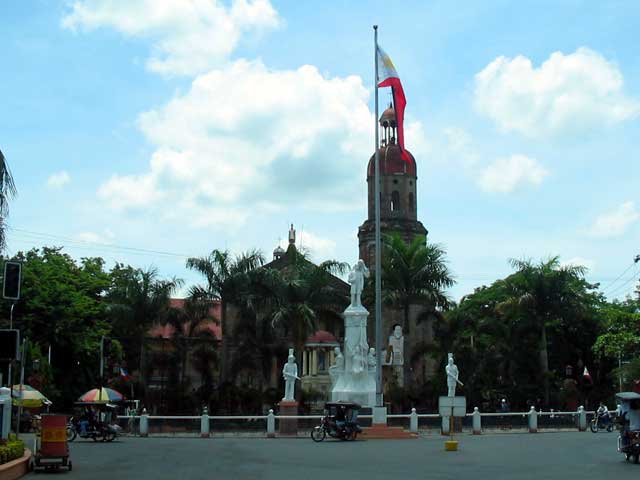
From Pulilan, I was off to Baliuag to take a photo of their old municipio which is now a museum. I like the way Baliuag is planned, with a glorieta in the middle of town. The church and convento are well-preserved. In front of the church is a grand monument to Dr. Jose Rizal complete with a pair of sphinxes on either side which is so art deco.
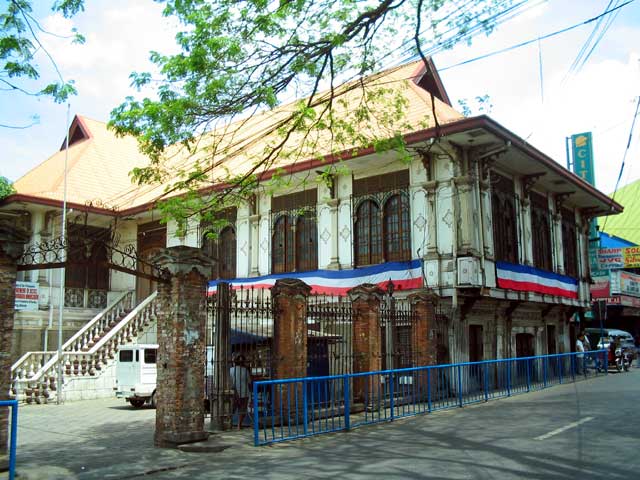
The old municipio is a few meters away along the road to San Miguel. After taking some snapshots, and since I felt like exploring some more, I decided to visit San Miguel de Mayumu since the municipio there was also built during the Spanish colonial period. It however wasn’t the main attraction of the town.

I’ve been there several years back and the elegant colonial homes were just splendid! But I was surprised to find many of them in a state of decay, including the three-storey Victorian Cake House which is always featured in coffee table books on Philippine architectural heritage.
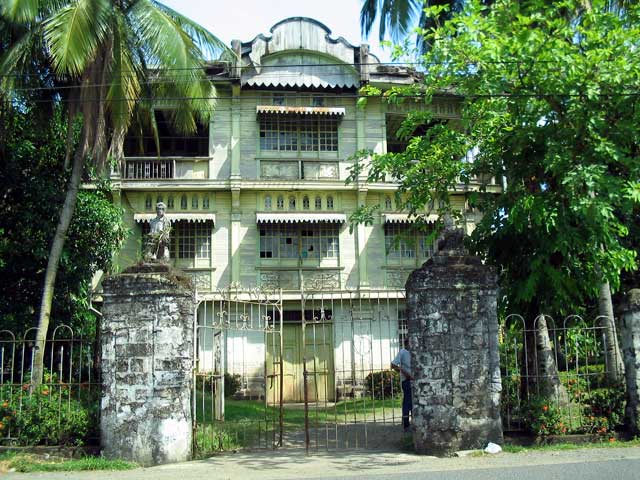
There is a twist to the third floor since this was rare in the bahay na bato. According to the story, "a macho farmer married the landowner's daughter. To out-do his father-in-law, the farmer built the tallest house in the area: so that the father, on passing the threshhold, had to look up to his son-in-law! The third level had a massive ballroom where the elite would throw balls as entertainment between sugar crops."

San Miguel is one of the few well-preserved towns which have yet to be declared by the National Historical Institute. Yes, the NHI board has yet to declare San Miguel, Bulacan and many other heritage towns! And while these historians sit down and take their time, many centuries-old homes are going down, taken for granted by the very institution mandated to protect them.

How sad it was to see a well-preserved heritage town in such a sorry state. I wonder why the Provincial Government of Bulacan, which I have known to be a staunch advocate of culture and the arts, is allowing these houses to decay and remain in such a state of neglect given that San Miguel’s ancestral homes are among the showcases of the province?
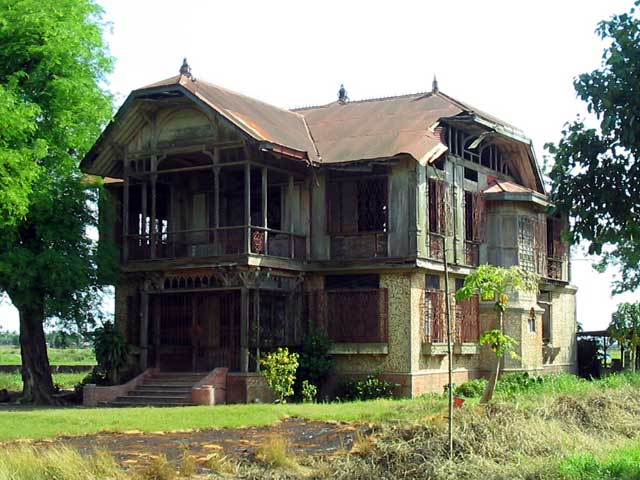
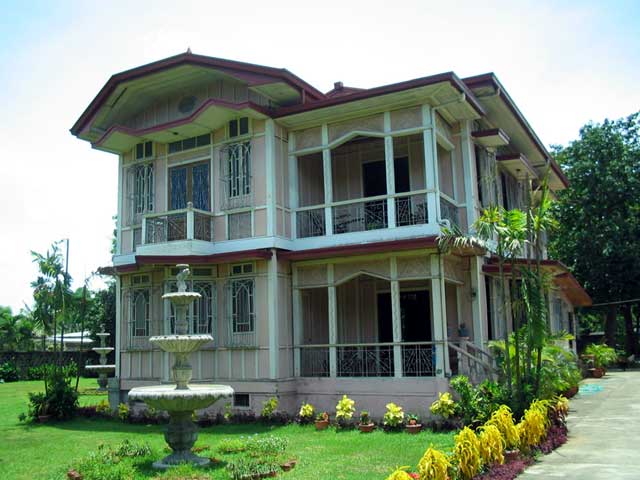
On the way back, I took a photo of the Ilusorio House in San Ildefonso which was along the highway. Aside from its outstanding architectural features, the house stands as a poignant reminder of the horrors of the Second World War where women from an entire barangay (Mapanique, Candaba) were locked and raped repeatedly by their Japanese captors. These wives, mothers and daughters, collectively known as the Malaya Lolas, had lost their husbands, fathers and sons who were tortured and massacred by the Japanese Imperial Army. Sigh!

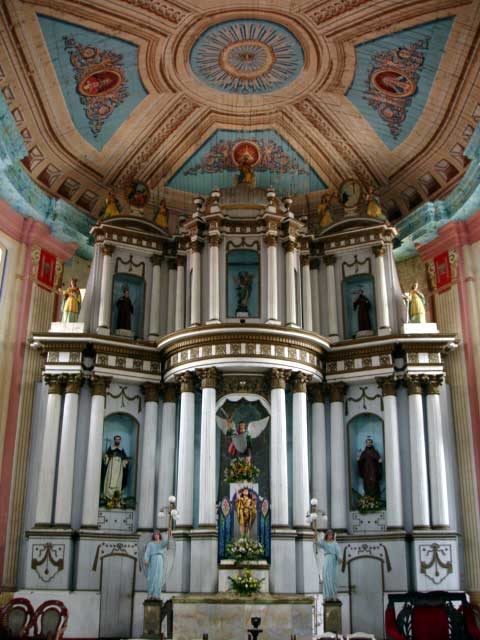
It was also suggested that I pass by San Rafael to check out the old houses. There were some nice ones but not as much as San Miguel. Since I was in San Rafael, might as well visit the church in Angat which was featured in the book of Fathers Javellana and Galende, Great Churches of the Philippines.
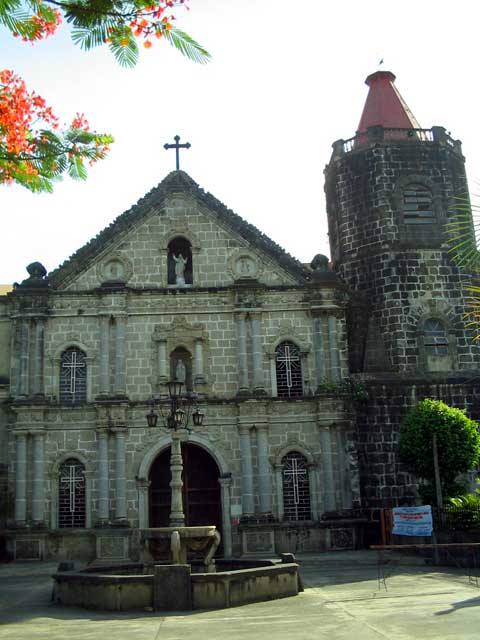
The exterior was charming! But the interior was just shocking, an excessive use of gold leaf! Just to make things clear, what was done inside the Angat Church was a renovation and not a restoration. For it to be a restoration, it must approximate the original interior of the church.

The new ceiling murals were just too loud and modern for the old colonial charm of this church. As I told a friend (the one who did the interior was also a friend), you don’t put opulence when it was previously not there. In fact, the elegance of the Angat Church was in its simplicity, now erased by a rampage of gold leaf.

One must not impose his style on an old church. That goes for priests, parish pastoral councils and the architects and interior designers they hire to renovate them, who most of the time go overboard with decorations and details. We must leave old churches as they are because these are testaments to the craftsmen and artisans who designed them.

Additions should not overpower the original design. I wonder how these architects and interior designers would feel if a hundred years from now, their works would be eradicated by future architects and interior designers who like them impose their style on previous masterpieces.

Anyway, enough said. From Angat, it was off to Manila. I took the longer, more scenic route via Norzagaray. The foothills of the Sierra Madre offered a relaxing view. But there were eyesores as well, quarrying plants and their towering machinery. Sigh! The drive was quite long thanks to the slow traffic as I neared Metro Manila. It would take me to San Jose del Monte City, North Caloocan and finally, Fairview where traffic management was horrible! Mayor Belmonte should fire his traffic enforcers and ban undisciplined jeepney drivers. Hmmmm... there wouldn't be any jeeps left then! Hehe! I had driven a total of seven hours! And now it's time for me to rest.

Saturday, June 03, 2006

Manila: National Artist Pablo Antonio’s work to be demolished

What are people doing to Manila's heritage? It seems the uglification of Manila is moving forward at such an alarming rate. The sad part is our utter disregard for the works of people we call National Artists. Why do we give out the award in the first place if we don't even care whether their works are preserved for future generations of Filipinos to appreciate?

I got this from Richard Tuason Bautista of the Heritage Conservation Society, "This morning (3 June 2006) during our taping and inspection of the ongoing demolition of the Avenue Theater and Hotel, we learned from the EVJ Demolition Team, with representation of their general manager Mr. Esteban Toting, that the Galaxy Theatre is next to face the demolition crew.

"Galaxy theatre is a work of National Artist for Architecture Pablo Antonio. It may not be too late to save this one. But how to save it, an uproar from the public is needed."

We should not sit down and simply watch while what's left of the Pearl of the Orient and its capital city, goes down one by one! To the National Commission for Culture and the Arts (NCCA), National Historical Institute (NHI) and the Cultural Center of the Philippines (CCP), it's about time you guys take a stand and protect the works of our National Artists! And to all of us ordinary citizens, let's write Mayor Atienza and tell him to stop giving out demolition permits for Manila's architectural heritage!

In fact, the NCCA lists the Galaxy Theater as one of Antonio's major works! Again, for those who would like to save this heritage structure, you can call or fax a complaint to Mayor Lito Atienza at 5276063 or 5274991 or send an e-mail at mayor_atienza@cityofmanila.com.ph.

Check out Ellen Tordesillas' blog for more comments about Atienza's latest rampage.

Related articles
Cinema designed by National Artist faces demolition

Thursday, June 01, 2006

Manila: Save Manila from Mayor Atienza!

This is the third entry with the word save in such a short span of time. The ignorance of our local government officials, moreso in the nation's capital city, is getting to be really depressing. It seems Mayor Lito Atienza is living up to his name as Manila's heritage destroyer. In the PDI article Arroyo orders rehabilitation of endangered buildings (May 31, 2006), Atienza calls for the demolition of the Luneta Hotel Historical Landmark! It is difficult to fathom how a mayor would even consider doing such.

The article says, "However, the mayor called on the DPWH and the owners of abandoned private buildings to demolish the structures because these posed a danger to the public.

"He cited the Veteran's Bank Building in the Port Area, the Royal Hotel on Carlos Palanca Street and the Luneta Hotel on T.M. Kalaw Avenue, among other buildings.

"These are abandoned buildings," Atienza said. "Uninhabited structures tend to become brittle as the years pass, and this is dangerous."

Photos of the Luneta Hotel came from the Heritage Watch Forum. The white building to the right of the hotel is another pre-war structure, the University Club Building.

The Luneta Hotel was declared a national historical landmark by the National Historical Institute and is thus protected by P.D. 1505. According to the decree, "Sec. 5. It shall be unlawfully for any person to modify, alter, repair or destroy the original features of any national shrine, monument, landmark and other important historic edifices declared and classified by the National Historical Institute as such without the prior written permission from the Chairman of said Institute.

"Any person who shall violate this Decree shall, upon conviction, be punished by imprisonment for not less than one year nor more than five years or a fine of not less than one thousand pesos nor more than ten thousand pesos or both, at the discretion of the court or tribunal concerned."

After chopping down centuries-old trees in Manila's last lung, the Arroceros Forest Park; demolishing the art deco Jai Alai Building in order to build a Hall of Justice which up to today has not begun (the lot where the Jai Alai Building used to stand is still a gaping hole in the ground); building a park and ride facility in the Mehan Gardens Historical Landmark, an archaeologically rich area being the site of Manila's Parian, thus destroying evidences of our rich culture; and getting rid of the YMCA Building and San Lazaro Hippodrome to build SM malls, sad to say SM City Manila now towers over the Manila City Hall and the area has become so congested and ugly; he is at it again!

Congratulations for a job well done Mayor Atienza! Kudos to your Patayan ang MayniLA program!

Sunday, May 28, 2006

When was the last time you displayed the Philippine flag?

When was the last time you displayed the Philippine flag outside your home? According to Section 7 of RA 8491 - An Act Prescribing the Code of the National Flag, Anthem, Motto, Coat-of-Arms and other Heraldic Items and Devices of the Philippines:

"SECTION 7. The flag shall also be displayed in private buildings and residences or raised in the open on flag-staffs in front of said buildings every April 9 (Araw ng Kagitingan); May 1 (Labor Day); May 28 (National Flag Day) to June 12 (Independence Day); last Sunday of August (National Heroes Day); November 30 (Bonifacio Day); and December 30 (Rizal Day); and on such other days as may be declared by the President and/or local chief executives."

May 28, 1898 was the day the Philippine flag was first unfurled after the Battle of Alapan, where the Philippine Revolutionary Army lead by Aguinaldo defeated the Spanish Army. This day is recognized today as National Flag Day.

As one Filipino nation, let us display the Philippine flag outside our homes and offices from May 28 (National Flag Day) to June 12 (Independence Day)!

Tuesday, May 23, 2006

Manila: Save the Avenue Theatre and Hotel

Manila was the second most devastated city after the Second World War. Most of the architectural heritage that earned for us the moniker "Pearl of the Orient" was lost in the hostilities. With so little left, we must thus endeavor to preserve what is left of our heritage. It is thus sad to hear that so many heritage structures are lost at such an alarming rate.

I got this from the Heritage Conservation Society: "For those who would like to save this heritage structure, you can call or fax a complaint to Mayor Lito Atienza at 5276063 or 5274991 or send an e-mail at mayor_atienza@cityofmanila.com.ph.

"This building was designed by National Artist for Architecture, Juan F. Nakpil in the 1930s with 1950s renovation of the same. It is among those buildings with a hotel, office space, and theatre. For those who are not familiar of it's location, it is along Avenida Rizal corner Soler, beside National Bookstore."

At the right is a photo of Avenue Theatre, a proof that it did surive the Second World War! It had survived this long. What a pity if we allow it to go down just like that.

Visit "Heritage Watch," a forum website, for more information...
http://www.skyscrapercity.com/showthread.php?p=8553348#post8553348

Related Article
From architectural landmark to parking lot

Sunday, May 21, 2006

Manila: Poking around the old millionaires' row in San Miguel

It was another adventure with Manila's streetwalker, my tokayo, Ivan ManDy. This time, it was in the most happening place in Manila before the war and the birthplace of our national beer... San Miguel!

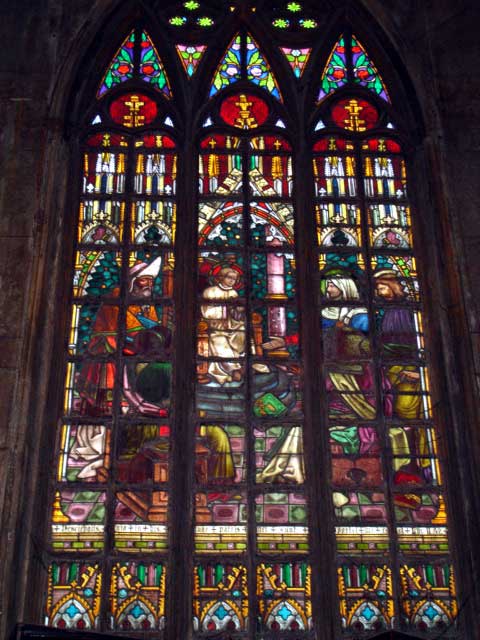
Our walking tour actually started in Quiapo, in Asia's first all-steel church, the Basilica of San Sebastian. After looking around, I'm always fascinated by the Gothic architecture and stained-glass windows of this church, we were off to San Miguel. From San Sebastian, it was a short stroll towards Mendiola and its American period schools.

The next stop was a little chapel in San Beda College known as the Abbey of Our Lady of Montserrat. According to the history of the Abbey, "In 1895 a group of Benedictine monks from the Abbey of Montserrat in Spain came to the Philippines and worked as missionaries and pastors in Surigao. Later they moved to Manila and in 1901 founded San Beda College. The community was raised to a priory in 1904 and in 1925 was elevated to the rank of Abbey with the titular of Our Lady of Montserrat."

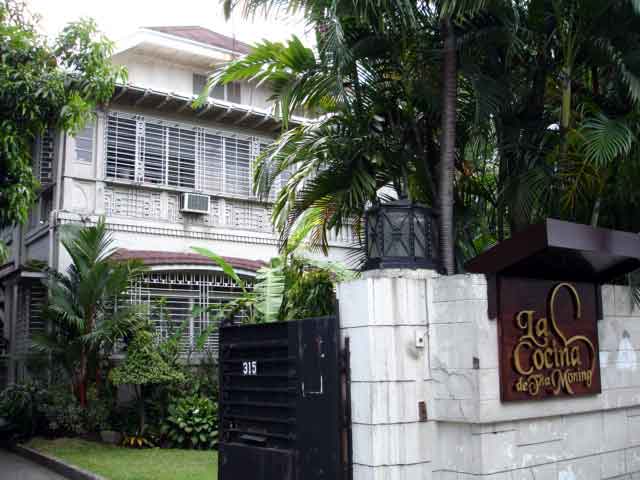
From there, it was through the Malacañang gates and security checks galore. Since we had a reservation at the La Cocina de Tita Moning (they had a letter with the guards complete with the names of all the guests), they let us in.

But this was a very sad picture of our country... barbed wire along the sidewalks ready for action when needed; a paranoid security detail always on hightened alert (even with the rallies going on in Bangkok, you could easily marvel at the architectural beauty of their government houses); the once see-through walls of the elegant old mansions in San Miguel now covered with metal sheets; I do hope the Malacañang complex becomes an area of the people again where Filipinos could walk around freely and enjoy their history and heritage. In fact, our bike escort (yes, we had a guard on a bike monitoring us while we were inside) did not even allow us to take a peek at Kalayaan Hall from the gates.

From Mendiola, we took a walk down Arlegui where more mansions could be seen. One of the mansions of interest is among the list of palace guesthouses. Known as the Arlegui Guesthouse it served as the official residence of two presidents namely Corazon Aquino and Fidel Ramos.

According to the Malacañang website, the house is "a remodeled and enlarged 1930s mansion owned by the Laperal family. It later housed the Japanese Embassy, the National Library and the Presidential Economic Staff, one of the agencies that was later merged with another to constitute the present National Economic and Development Authority (NEDA). Mrs. Marcos doubled the size of the mansion when it was converted to a guesthouse; it now has two towers where it used to have one."

It was straight down the road on Arlegui and even more mansions. We then made a left on San Rafael where the Legarda House was located. The house had been converted into a fine dining restaurant called La Cocina de Tita Moning, giving their clients a glimpse into the family recipes and lifestyle of the Legarda household. There are set meals available for a minimum of two and a maximum of 50 people. But for us, it was just a sampler. For our welcome drink, we had lemon grass tea. And for our meal, it was pasta with the special chopped tomato sauce, baked chicken with garlic and banana cue for dessert, which was accompanied with vermouth as its "syrup." The houses also had a shop where one could purchase bottled family specialties such as the queso de bola spread, vinigarettes, and sauces.

After second and even third servings and some chatting here and there, we continued our walk. Right beside the Legarda House is another well preserved art deco mansion which today is the Malacanang Clinic. This used to be the home of former chief of staff of the Philippine Army, Dr. Basilio Valdes.

From San Rafael, we took a right back on J. P. Laurel and exited the secured area of the palace complex towards the San Miguel Church. But we made a brief stop in front of an empty part of the palace lawn where the offices and factory of the tenth largest brewery in the world was first built over a century ago. The San Miguel Brewery factory is no longer there. That alone would have been a museum worth visiting if it were still standing today. Sigh!

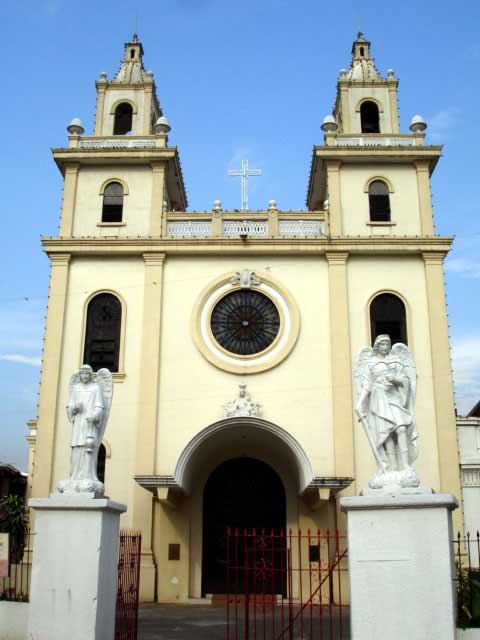
The San Miguel Church has a lot of history attached to it. It was for several years in our history the seat of the Archdiocese of Manila when the Manila Cathedral lay in ruins after the war. The church was host to celebrity weddings as well including that of President Ferdinand Marcos to then Imelda Romualdez.

We were nearing the end of our tour. Our last stops were two more Malacañang guesthouses. "The Goldenberg Mansion (so called after the previous owners) was informally referred to by Mrs. Marcos as the 'big antique.' A historic structure built by the Eugster family (probably Spaniards long returned to Spain) about a hundred years ago, it was the office of the Marcos Foundation, a cultural heritage structure. It was a combination residence and shampoo factory when bought by the Marcoses and exquisitely restored by Architect Leandro Locsin in 1971.

"It held Mrs. Marcos' collection of excavated porcelain and pottery, Ban Chieng prehistoric pottery from Thailand and Filipiniana book rarities, and treasures such as a statue from Angkor and Chinese jade furniture.


"The Teus house next door was purchased and converted to a guesthouse in 1974, under the supervision of decorator Ronnie Laing. It has a large living-dining area that held a display of antique European silverware (since sold at auction), including some by famous 18th and 19th century silversmiths Paul de Lamerie and Paul Storr. Much of these were apparently given to the Marcoses on their silver wedding anniversary."


Talk about opulence in the Philippines! Despite their many faults, the Marcoses, particularly Imelda and her edifice complex, made Manila the most happening place in all of Asia. The results of these whims and caprices are architectural legacies such as the Cultural Center of the Philippines among many others.

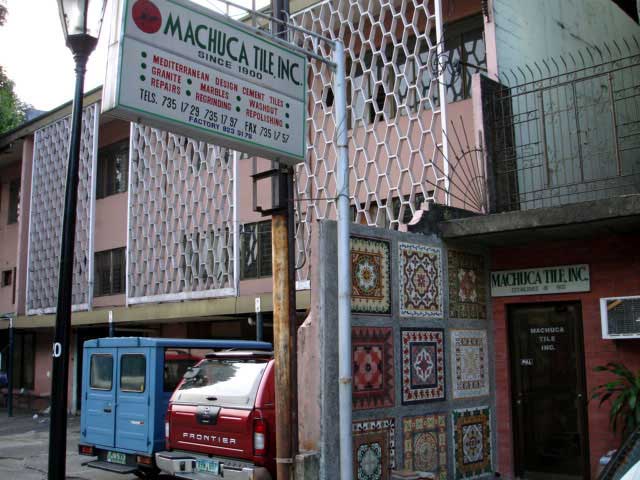
In front of the two mansions was a shop which should be of particular interest to those who would like a piece of Philippine heritage in their homes. The old tiles we see in old houses and churches are made by companies such as the Machuca Tile Company which has made tiles since 1900. Their office is in front of these mansions and if you check the photo, their phone number is in the sign.

That was the end of the tour and it was back to San Sebastian by jeep. That's it for now.

Thursday, May 18, 2006

Iloilo: Save Calle Real

The image “http://www.philippines.canurb.com/callereal/savecallereal.jpg” cannot be displayed, because it contains errors.

After my visit to Iloilo City, I knew just by looking around at all the architectural heritage, that it could be a showcase city for proper urban renewal. I was delighted to find out that saving Iloilo City's architectural heritage was already in the works and the local community is going on an all out campaign for heritage conservation. As the
Save Calle Real materials mention: "Iloilo City is a virtual time machine that will transport anyone back to its colonial past. While malls have risen in various corners of the city, they could not outshine the splendor of its colonial buildings that adorn its Calle Real, the first commercial center and its adjoining districts. They are not only testimonies of city’s rich cultural heritage but are tourism assets worth promoting."

On 25 May 2006, concerned citizens and stakeholders will convene at the Iloilo Grand Hotel to participate in a forum that will dissect the draft Iloilo City Downtown Central Business District Heritage Conservation Guidelines and help plan for Calle Real’s future. For more information, check out the website of Save Calle Real. Thumbs up to the organizers of this noble endeavor! I hope other cities follow suit.

Tuesday, May 16, 2006

Quezon & Laguna: Pahiyas, Mayohan sa Tayabas, atbp.

This was my second straight year at the Pahiyas festival. Due to the storm which had just left the country, Lucban was covered by a blanket of fog. In fact, for most of the morning, the climate was like that of Baguio. The air was cool but a little more humid than in the summer capital.

We left the resthouse at 5:45 a.m. by tricycle since we didn't want our van to get stuck in town. For breakfast, it was Lucban longganiza, sinangag and fried egg. Then we joined the procession which left the church at 7:10 a.m. The procession is the best way to view the decorations since it is only the homes and businesses along the procession route which are decorated.

The procession route changes every year. And you have to wait several years before you are given the chance to decorate. For one, decorating is very costly and doing it every year will create big dents in one's budget. So the route changes to give residents a chance to join in the festivities once or twice in a decade and a chance to save up and prepare for their next turn.

I felt that last year was a bigger celebration than this year. For one, the weather was still unpredictable. And it even rained the night before. Second, the Pahiyas fell on a Sunday last year so the crowds were thicker. I was also disappointed that they used a school band in crew neck t-shirts for the procession. I was charmed by last year's band which was elegant in their traditional band costumes. Oh well!

Since I have a previous entry on the Pahiyas and other San Isidro Labrador celebrations, please check it out for detailed information. The photos of the entry are in Friendster so if they blocked Friendster in your school or office, that would explain why the photos don't show up.

Anyway, after going around to check out the decors and do some shopping, we went back to the resthouse before lunch to load all our stuff in the van. Our next stop was the neighboring town of Tayabas, the former provincial capital. Just like many Philippine towns and cities, the elegant town of Tayabas was bombed by American forces. Sigh!

The town lost all of its grand mansions in the poblacion. I was told that the Americans were targeting the church but for some reason, the bombs missed. And thank God they did since it would have been such a tragedy if American bombs destroyed this national cultural treasure!

The Minor Basilica of St. Michael and the nearby Casa Communidad de Tayabas is all that remains of this once grand town. Sigh! I wonder how many grand old towns and cities the American forces carpet bombed during the Second World War.

We were lucky since Dr. Leticia Yap was in town. Dr. Yap is a native of Tayabas but lived most of her life in San Fernando since her husband is from there. She was at one time a provincial board member of Pampanga. Anyway, we joined her for lunch at their home. After the sumptuous lunch, we were off to Sariaya to view the old houses.

For some reason, Sariaya was better the first time I visited last year. The mayor built a big eyesore, a multi-purpose hall, in a very elegant art deco town plaza. They could have at least made sure that the architecture of this new structure matched the flamboyance of its surroundings.

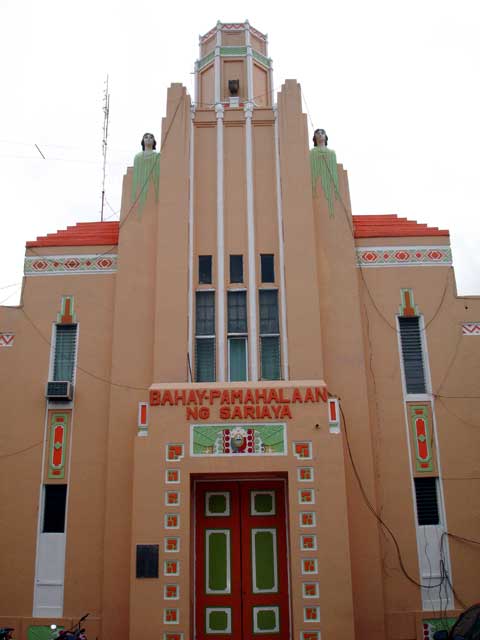
But there was an obvious change with the colors of the municipio. From a plain white facade, the current colors exude the art deco flair. I know it has elicited mixed reactions but if you want to be historically accurate, you will have to follow color schemes of the period, no matter how flashy they are. Again, a detailed account is in last year's entry.

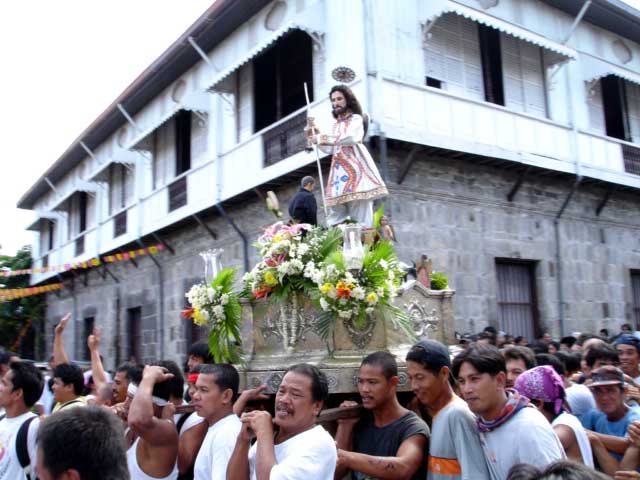
After a short walking tour, it was back to Tayabas to witness the hagisan ng suman. For a Monday, I was shocked to see that there were double or even triple the number of participants in the procession. Was this a sign of trying times? Because last year, I could still stand behind the anda of San Isidro Labrador. But this year it was a mad rush for the suman flying in the air in the thousands. And I didn't want to suffer a Wowowee! simply to take photos in the middle of the rushing crowd. Hehe!

But from the sidelines, this practice was so intriguing and definitely worth watching! I wonder if there have been any studies made on this and similar religious practices such as the Nazareno procession in Quiapo; why people would risk their lives driven by an ounce of faith, and in the case of Tayabas, a possible windfall of suman.

From Tayabas, we motored back to Lucban and then to Majayjay to visit the old church which is also a national cultural treasure. Driving along the mountain roads offered magnificent views of the slopes of Mount Banahaw and the numerous streams which flowed from it. Looking up at the towering fortress-like Church of San Gregorio Magno was just awe-inspiring. I could just imagine how it looked when there were just a few houses and forests all around it.

We then proceeded to the Nagcarlan Underground Cemetery but it was closed when we got there. At the gate was a sign which said that due to the government's energy conservation program, the cemetery was open only from Tuesday to Saturday. Hello? I could understand Monday but to close it on a Sunday, that is ridiculous!

Anyway, after a few photos, it was back to Manila. What a day! More photos in My Heritage Photos. Click on Laguna and Quezon.
Related Posts with Thumbnails