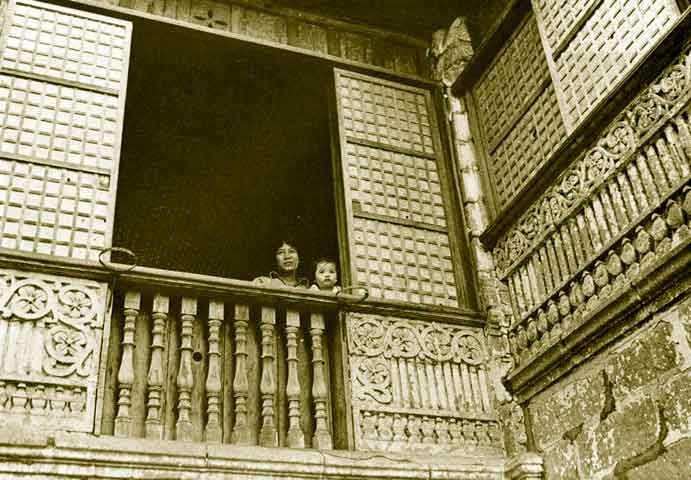
I have not seen the Bagac project personally. But from several friends in the Heritage Conservation Society, I was able to get the following: there are already about eight to ten heritage houses that have been transferred to the property in Bagac, Bataan. Many of them are reportedly from Bulacan. From Pampanga, there are two namely the Reyes House from Candaba, which was said to be the oldest and one of the grandest homes in Pampanga before it was transferred, and an unidentified house from Mexico. Also purchased was the Enriquez Mansion on Hidalgo Street, Quiapo which will be transferred soon.
Another home rumored to have been purchased is the Mercado House in Bustos, Bulacan which was ironically featured in the 2006 heritage homes calendar of Shell. Obviously, this house does not need to be “saved” and is best kept where it is standing right now.
Bustos, Bulacan has a very unique architectural style found nowhere else in the country. Because of its proximity to the forest and mountains, the Mercado House was built like a fortress. This unique type of 19th century house found only in Bustos is characterized by its all stone exterior since it was unlike the regular bahay na bato which was stone below and wood above. There are said to be about 2 to 3 of these houses left in Bustos and the Mercado House is arguably the best and grandest example of these.
It has carved stone corner pillars and carved stone garland and crucifix motifs in the entrance. The house also had peep holes for rifles to aim at tulisanes. The town thus has a different air and taking the house out would leave a large vacuum in the historical fabric of the community.
After hearing of the news, the Pamanang Bulacan Foundation immediately called for an emergency meeting of its Board of Directors. They have also alerted Governor Josie dela Cruz about these developments and we will get her response soon. I spoke with the chairman of the foundation who voiced out his strong opposition to the move. Maybe for the less-signifcant houses, it would not raise too much of an alarm. But for a house as prominent as the Mercado House in Bustos which is significant not only to the town but to the entire province of Bulacan, that is a different question. It just shows that when you go around shopping for the best examples of Philippine heritage and uproot them from their communities, a lot of ethical questions arise.
The problem is the fact that the purchases are sometimes kept from the local community, especially the local heritage foundations. And thus, they are caught off guard. When they find out, it is already too late. Watch out Bulacan since they're also after the Constantino House in Balagtas (Bigaa).
On the Bagac property, it was also discovered that there are many issues regarding the location and there is a large possibility that transferring them may do more harm than good in the long-term. First, no lime plaster was used to protect the stones. And given that the houses were reconstructed right beside the sea, the strong winds could easily wear out and weather the delicate adobe. The air will also cause salt encrustation on the stone which would lead to the disintegration of the adobe. Damage to the adobe would thus be faster because of its location by the sea.
Second issue is the fact that the person tasked with reconstructing the homes is not a trained restoration architect. As a result, the reassembling of the houses is not correct, proportions are wrong, unnecessary embellishments were added, and the setting is just not right so houses look funny and out of context. The way the “town” is laid-out does not follow any Spanish colonial tradition in the Philippines and is not authentic to any period of our history.
Some homes are from urban areas where in the natural setting, they are supposed to stand side-by-side and close to the street. One example is a house from Binondo which is a row house. It is funny to see a row house without the row and even a garden in front!
Issues of flooding also came out. The houses should have been reconstructed further inland. It is reported that the Bagac Church which is already one kilometer inland is still reached by flood waters especially when the waves are high. Moreover, we all remember the West Luzon Fault which became news when the issue of the safety of the Bataan Nuclear Power Plant in neighboring Morong was raised. Thus, the proximity of Bagac to a faultline makes the property prone to earthquakes and more so, because of its seaside location, to tsunamis.
Again, we repeat our call for a moratorium on this project until it is discussed in length in the proper forum.
OT: Congratulations to Manny Pacquiao on his victory! Thank you for lifting up the spirits of the Filipino nation. But Santa Banana! I will have to agree with Emil Jurado on his spending and gambling spree. As he writes "somebody like Pacquiao who is idolized by millions of Filipinos also has an obligation not to indulge in conspicuous consumption while millions languish in poverty." Check out the full column here.
Photo credits: Philippine Ancestral Houses (by Fernando N. Zialcita, et al)
It's a spectacle you should not miss! A showcase of Filipino ingenuity, San Fernando's giant lanterns never fail to bedazzle the crowd! Watch twelve barangays battle it out with their 18-foot lanterns, each with at least 5,000 light bulbs, on December 16, Saturday, 7 p.m. at SM City Pampanga, City of San Fernando. Check out a previous entry on the festival here.
It's best to arrive at the venue early. I suggest you park at SM City Pampanga before lunch. Have lunch there, watch a movie or whatever since if you arrive later than that, traffic will start to get bad since over 100,000 people watch the event annually. Also park near the exit since you'll have a hard time getting out when the event is over. For more information, contact the City Tourism Office at (045) 961-5684.
Ivan About Town in the news While I was doing my regular Internet search, I found the following: ■ Old houses mirror revolutionary past (15 Nov 06, PDI) - This Inquier article quoted one of my blog entries on San Miguel, Bulacan. Yikes! It just shows I'm being read. Haha! I hope my good friend Prof. Ambeth Ocampo does not get mad at me for my comments. But I really am hopeful that the NHI will declare San Miguel a National Historical Landmark soon; ■ Mekeni Tuki Ka! reaping rave reviews from Kapampangans abroad (11 Oct 06, Pampanga News) - Wow! Governor Mark Lapid thanked me for helping promote the Pampanga Tourism MTV and uploading it on YouTube.com. Over 28,000 have viewed the video as of today; ■ Pampanga heritage supporter is 2006 'Unlad Pilipinas' winner (14 Sept 04, SunStar Pampanga)
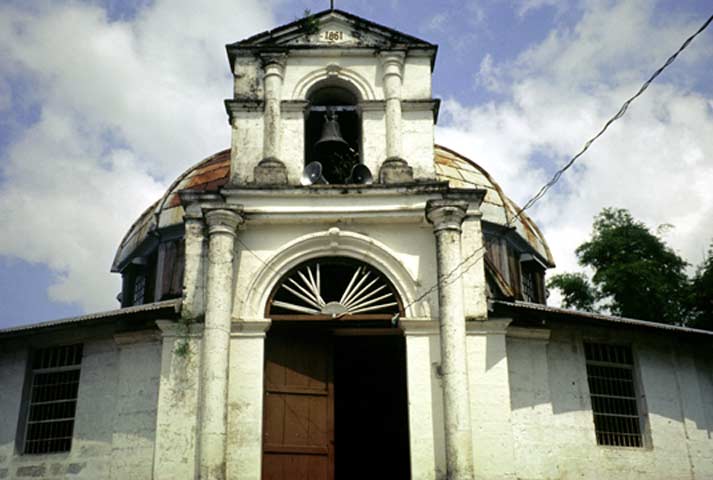
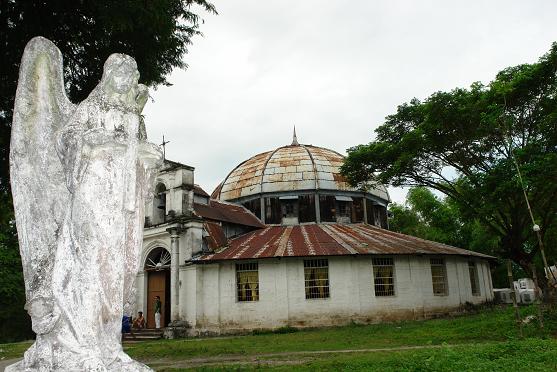
It's time to post again about my Philippine travels. Today, I visited Porac, one of the towns of Pampanga. Although Porac is more known for its natural sites such as Dara and Miyamit Falls as well as the Porac Highlands, it also plays host to some of Pampanga's important cultural heritage structures. One of these is the last intact (meaning unrenovated) hacienda chapel in the province which is located in Barangay Pio.
I have been to Pio several times before but we decided to visit today after it had been rumored that someone had purchased the chapel and will be transferring it to Bagac, Bataan! To give you a backgrounder on the Bagac project, check out this PDI column. As a result of the news, the Pio Chapel is fast becoming a rallying point for Pampanga in the fight to preserve its heritage and is now sparking a debate on the ethics of transferring heritage houses and structures.
Heritage structures must remain where they are because they are part of the historical fabric of the communities they are located in. There may be some cases however when transferring a heritage structure may be better than leaving a structure where it is, especially when it is highly likely that the structure will be lost or demolished in the near future.
But, when you go shopping for heritage houses and structures, especially in places where they are an important part of the historical fabric of the community, is that right? I was told that many of the houses were purchased from Bulacan, including one from the heritage town of San Miguel de Mayumu (which now serves as the house of Bishop Soc Villegas) and another house in Bustos which was ironically featured in the heritage house calendar of Shell. I wonder if Governor Josie dela Cruz knows about this.
In Pampanga, the grand old Reyes House of Candaba, which was the oldest surviving house in the province and the house where Noli Me Tangere was shot several decades back, is now in Bagac. News circulating is that Mayor Jerry Pelayo is not happy and is making moves to protect what is left.
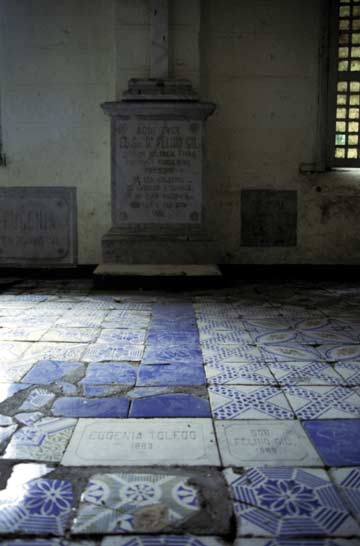
We got to chat with the parish pastoral council president and a barangay kagawad while we were in Pio. Mass is said at the chapel every Saturday at 5 p.m. It was built in 1861 as part of the hacienda founded by Don Felino Gil (who also founded the Escuela de Artes y Oficios, the oldest trade school in Asia, which is now DHVCAT) and his wife Dona Eugenia Toledo. Their descendants include actress Rosemarie Gil. But the property is no longer theirs since it was sold to someone from Bulacan who was said to have donated the chapel to the local community.
We were told that the Gils visited several times to cart off the antique furniture and artifacts inside their hacienda house and chapel. Nothing was spared including the piedra china flooring around the chapel and the house. The most infamous of these visits was in the 1980s when actor Dante Varona, who accompanied them, climbed the belfry of the chapel hoping to get the centuries-old bell. He was mobbed by the local community and they were chased away with tabak, an agricultural-based cutting bolo.
The chapel is very important to Pampanga because as I mentioned earlier, it is the only intact visita in the entire province of Pampanga. Aside from that, it is a circular chapel built during the Spanish colonial period, pre-dating the UP Chapel (which some claim to be the first circular church in the country) by 145 years!
The people of Barangay Pio in Porac are now up in arms after word reached them that their chapel was reportedly sold by a still unknown person and would be transferred to Bagac soon. The municipal government and the local community are now vigilantly guarding the chapel. And if and when the demolition crew comes to get it, they said they will protect it with their lives. Quoting them, "They could not even get the bell, what more the entire chapel!"
Now with that situation, is it still ethical to transfer a heritage structure to someone's private property? And even more so when news is going around that the structure is being transferred to serve as a decoration for their daughter's debut?
A moratorium on this Bagac project should be done until further studies are done on the location in particular since there are a lot of issues on the safety of the houses being built so close to the sea, and until the heritage community has fully digested this unusual project and threshed out the ethics of transferring heritage structures. Again, heritage structures are best kept where they are so that they are appreciated in the proper context vis-à-vis the environment they are built in.
Actively shopping for heritage houses for use as scrap material for homes or transferring them whole, and even worse, using coffee table books featuring heritage homes as shopping catalogues is simply detestable. The best way to save a heritage house is by educating the local community about the value of a heritage house, the significance of its architecture or former inhabitants to the local community, and its potential as a symbol for the community to strengthen local identity and pride of place.
Photo credits: Tonette T. Orejas (2nd, 3rd and 5th photo)
When President Manuel L. Quezon said, "I prefer a country run like hell by Filipinos to a country run like heaven by Americans." I'm sure he never thought that his wish would come true quite literally.
Senator Alfredo Lim was right when he berated the City Government of Manila for its greed. Two educational institutions in Tondo, both integral parts of Manila's heritage, and providers of free education to no less than 10,000 students in Tondo, will soon give way to shopping malls. Oh how Atienzic!
And the good senator and former mayor could not have said it better: "These two lands, inseparably identified with institutions devoted to education and imbued with memories of the Manileños’ past, having existed for decades as public schools, accommodating no less than 10,000 poor students of Tondo, for free, the Rajah Sulayman High School and Jose Abad Santos High School, are awaiting their unexpected and dreaded demise, as their death certificates have been signed by no less than the City Council, with the death sentence struck - with a thumb-up sign, by its City Mayor. As heralded, from the schools’ burial sites will rise luxurious malls: the stereotypical symbols of the modern care-free lifestyle – luxurious wares, expensive foods, entertainment centers, fully air-conditioned establishments."
He adds, "Without a doubt, this is the voice of gold, the whisper of wealth, heard and heeded by ears of avarice and greed."
OT: I updated my Multiply site and added some background music. Did you know that the instrument used in the Lonely Planet theme is the kubing, a jaw harp from the Philippines?
I arrived at the Guangzhou East Train Station at 11 a.m. I was met at the station by Jiajin, our liaison officer during the program who was nice enough to take me around Guangzhou during my last day in China. We hadn't been able to see Guangzhou during the program in Guangdong Province since the activities were in Dongguan City.
From the Guangzhou East Station, we took a subway to the Guangzhou Train Station (there are two stations in Guangzhou) since the hotel I was going to stay in was right beside it. It was convenient for me since right beside the hotel was the China Southern office and the pick-up point for the airport shuttle which left every 15 minutes. I paid RMB150 for a single room.
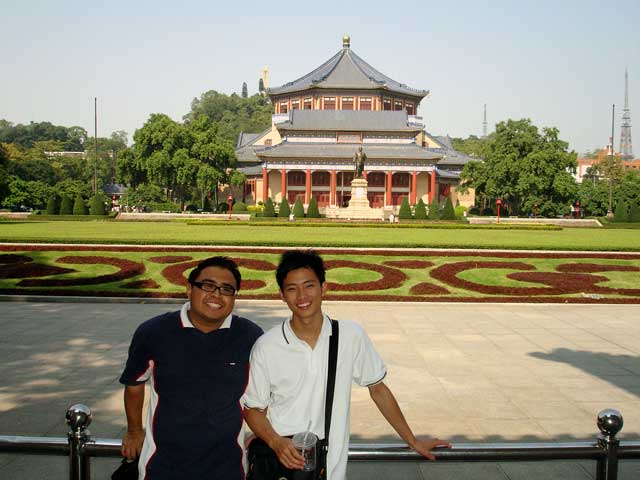
We had lunch at the KFC beside the hotel. From there, we took a subway to the Sun Yat-Sen Memorial Hall. The hall is situated on the southern slope of Yuexiu Hill and was constructed between 1929 and 1931 by the people of Guangzhou and overseas Chinese as a monument to Dr. Sun Yat-sen, the forerunner of Chinese democratic revolution.
Since Jiajin had classes at 3 p.m., we took a 40-minute bus to the Guandong University of Foreign Studies where he is a graduating student. I stayed at his dorm and surfed the Internet while he was in class.
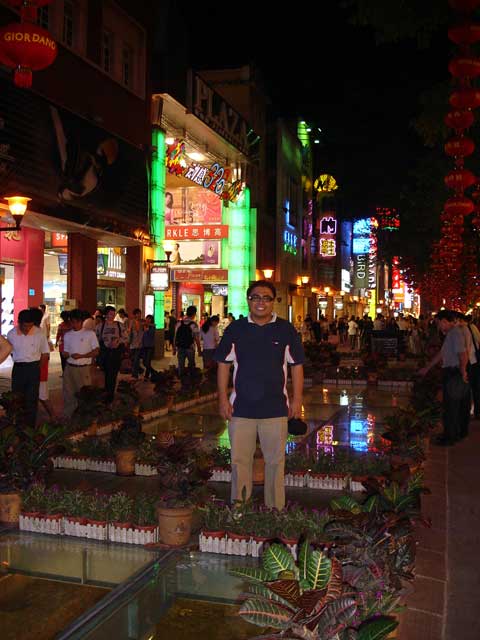
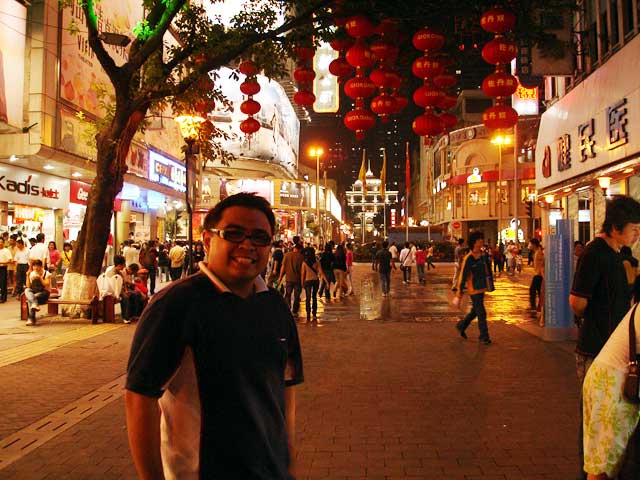
After his class, we took another bus back to the city center. I wanted to pass by a supermarket to check out the local food. We decided to buy dinner there. Got myself some rice noodles and vegetable pie while he got some dumplings. Also bought some dried fruits and my supply of water. From there, we walked towards the Shangxiajiu Walking Street (上下九商业步行街) a famous shopping area of Guangzhou.
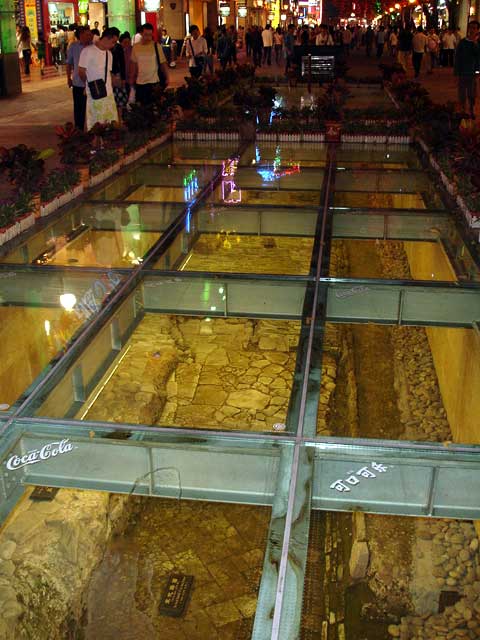
What I liked about the place was the glass covered display of an old street which was accidentaly discovered in 2002 during excavations for a redevelopment project. But instead of destroying the old street and other remnants of the city's heritage, like what Mayor Atienza did in Mehan Gardens and Cuartel Meisic, Guangzhou covered it with glass and it is now an attraction of the walking street.
It was not only one street but actually layer upon layer of streets from various periods dating back to the Tang Dynasty (618 to 907 AD). Between then and the period of the Republic of China (1912 to 1949), ten additional layers were added. The bottom grit layer is about 3 meters below the surface. At a depth of 4.5 meters, the remains of the Southern Yue Kingdom (203 to 211 BC) were found. From 7.9 meters below, the surface lies gray-red virgin soil, which reveals that the site was once a riverbed. If you check out the photo, each label is from a different period of China's history. I hope we are able to find things like these in the Philippines.
After taking some photos, we went back to the hotel to eat our supermarket dinner. Didn't stay up too late since my flight was early in the morning and I had to be up before 6 a.m. to catch the 50-minute shuttle to the airport. My flight back to Manila leaves at 8:45 a.m. Anyway, this is my last post on my China trip. Until the next adventure!
I arrived in Shanghaiat 7 a.m. this morning. I was met at the station by the staff of the Philippine Consulate. Since I had to catch my flight in Guangzhou on November 7, and the train from Shanghai to Guangzhou was close to 24 hours, I only had one full day in Shanghai. I was staying for a night at the residence of the consul-general in Shanghai who is my brod, Ambassador Jess Yabes.
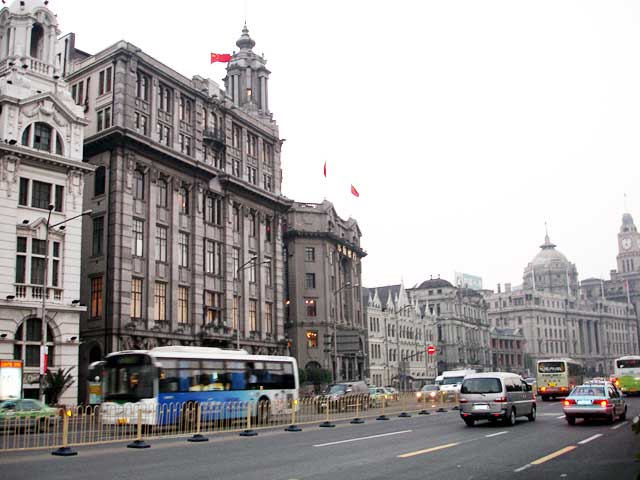
We went around the city first since Jess was expecting us at 9 a.m. So they took me to the Bund (外灘), one of the major attractions of Shanghai. The Bund is a living exhibition of buildings of various architectural styles which I wll discuss in detail later.
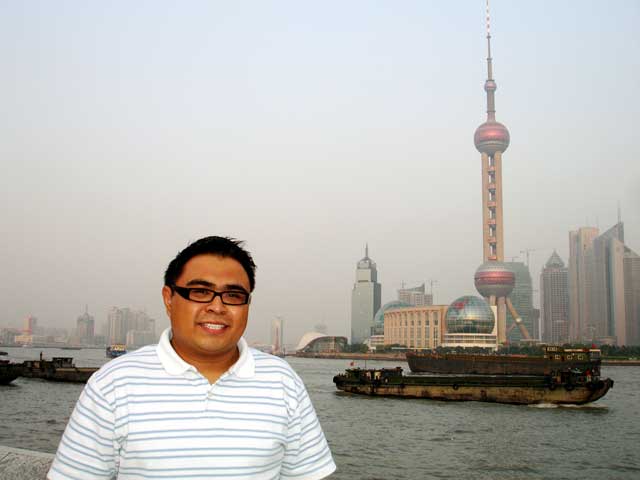
From the promenade along the Bund, you could see Pudong on the opposite side of the Huangpu River and another famous landmark of Shanghai, the Oriental Pearl TV Tower (东方明珠塔), the tallest tower in Asia and the third tallest in the world.
We then proceeded to the apartment where another brod, The World Tonight anchor Angelo Castro, Jr. was preparing to leave for the airport for his flight back to Manila. So after freshening up and getting settled, we proceeded to the Pudong International Airport to see Angelo off. Since there was a lot of time, we had coffee at one of the airport cafes. After Angelo left, Jess and I proceeded to The Portman Ritz-Carlton and had lunch at the Hanagatami Japanese Restaurant.
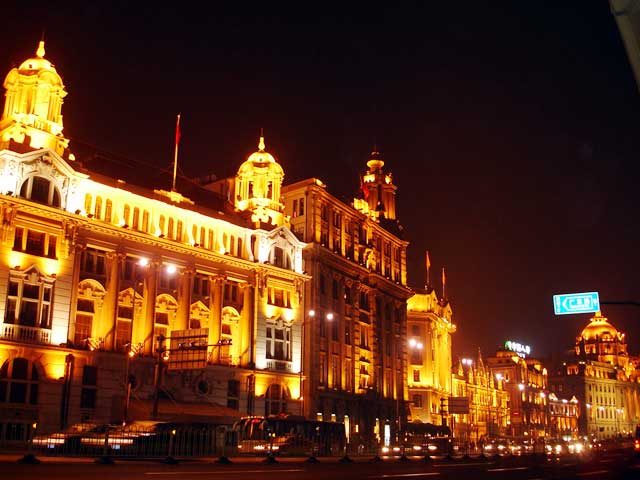
Since Jess wasn't feeling well, we went back to the apartment. I opted to rest for the afternoon too. I remember leaving the apartment at 4 p.m. to go back to the Bund. I wanted to check it out in the evening with the lighting and all.
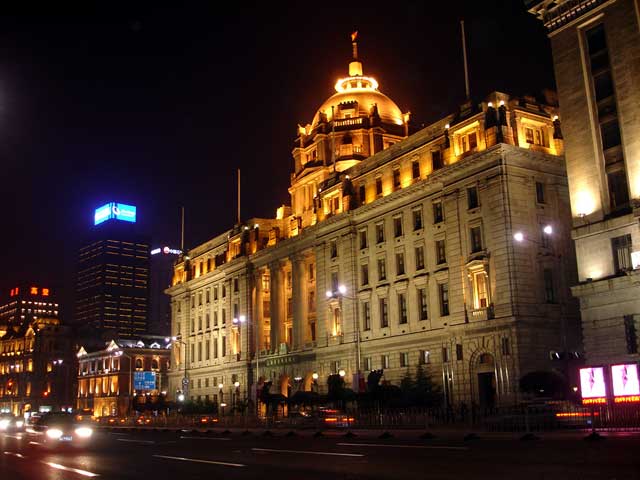
The Bund is actually an area along the Huangpu River which served as the historical core of the city. Originally a British settlement, it was the heart of a building boom in the late 19th and early 20th centuries which made it a major financial hub of East Asia. It hosted among others banks and trading houses from the UK, France, USA, Russia, Germany, Japan, The Netherlands and Belgium, as well as the consulates of Russia and Britain, a newspaper, the Shanghai Club and the Masonic Club.
Many of these buildings were preserved and today, the area houses 52 buildings of various architectural styles such as Romanesque, Gothic, Renaissance, Baroque, Neo-Classical, Beaux-Arts, and Art Deco. It is said that Shanghai has one of the richest collections of Art Deco architecture in the world.
One thing I try to do when I visit a city is take a river tour since it really gives you a feel of the place. I've done it in Bangkok and Singapore, as well as Hong Kong. In developed countries, riverfront properties are very expensive.
I hope they rehabilitate the banks of the Pasig River. There are still a lot of old structures in the Manila area, a sign of its rich history. While in the Makati and Pasig City areas, political will is needed to push for the relocation of factories elswhere so that the riverbanks could be redeveloped into open spaces and recreation areas for Metro Manila's citizens to breathe. I purchased tickets for a river cruise along the Huangpu River. The day cruises are RMB45 while the night cruises are a little more expensive. But you could get the 6 to 7 p.m. cruise which is still considered a day tour, but at the same time enjoy the magnificently-lit skyline of Shanghai. Make sure you are at the ticket outlet at least 30 minutes before your tour since the port is a distance away and they have shuttle buses which transport passengers from the Bund to the port.
The views of the Bund and Pudong from the Huangpu River were great! The cruise came with a narration in both Chinese and English, explaining the significance of the areas we passed. The only sad part was that I didn't bring my jacket since it was a little warmer in Shanghai than in Beijing. But it skipped my mind that temperatures dropped in the evening. So I guess you know what happened.
Anyway, I enjoyed the cruise. As soon as I got back to the Bund, I took photos of the Shanghai skyline as well as the buildings in the Bund.
I walked up to the Gutzlaff Signal Tower which was converted into a museum. One thing I noticed on the building was a granite marker which said "HERITAGE ARCHITECTURE." What made it more significant was the fact that it was installed by the Shanghai Municipal Government. How I wish the City of Manila would do that too instead of demolishing its heritage structures!
Tomorrow I leave for Guangzhou by train at 11:26 a.m.
Today was our last day in Beijing. My two companions were leaving for Guangzhou at 1 p.m. So they had to prepare for the 22 hour train trip back. Marlon did some last minute shopping and was up really early. My train for Shanghai was leaving at 7 p.m. so I still had time for one more attraction. And today, I was scheduled to visit my fifth UNESCO World Heritage Site in Beijing, the Summer Palace.
Known as Yiheyuan (頤和園), which literally means "Garden of Nurtured Harmony," the Summer Palace was first built in 1750 as the Qingyiyuan (清漪園) or Garden of Clear Ripples. However, it was ransacked in 1860 by British and French forces, together with the old Summer Palace, the Yuanmingyuan (圓明園). The Yuanmingyuan was totally destroyed but the Qingyiyuan survived.
The current palace was rebuilt in 1886 by the Empress Dowager Cixi who diverted 30 million taels of silver meant for the Chinese navy to finance its construction. Cixi used it as her summer resort. It was christened Yiheyuan in 1888. In 1900, during the Boxer Rebellion, it was again damaged by an eight-nation allied invasion but survived. It was again reconstructed in 1902.
Taking the cab was out of the question since the Summer Palace was quite a distance from the center of Beijing. I was told it was about 50 minutes by bus. For some reason, I was planning to leave at 8 a.m. but the next thing I knew, it was already 10 a.m. Hehe! Anyway, I was able to ask around which bus to take to the Yiheyuan and waitied at the bus stop. Just to be sure, I looked for the Chinese characters for Yiheyuan on the bus route posted at the stop and it turns out, the Summer Palace was the last stop of the bus. The cost of the bus was RMB5.
I finally arrived at the East Palace Gate of the Summer Palace after a long trip into the Beijing suburbs. I thought I could finish touring around in three hours but I under estimated its size since I found out that the complex covers an area of 290 hectares! So it was impossible to finish it before 3 p.m., the time I set for me to troop back to the city center to catch my train.
The through ticket to the Summer Palace is RMB50. I also bought an English map of the place at RMB5 if I'm not mistaken. So I started my trek around the palace. There was no straight route to visit all the important structures since they were scattered around Kunming Lake and Longevity Hill.
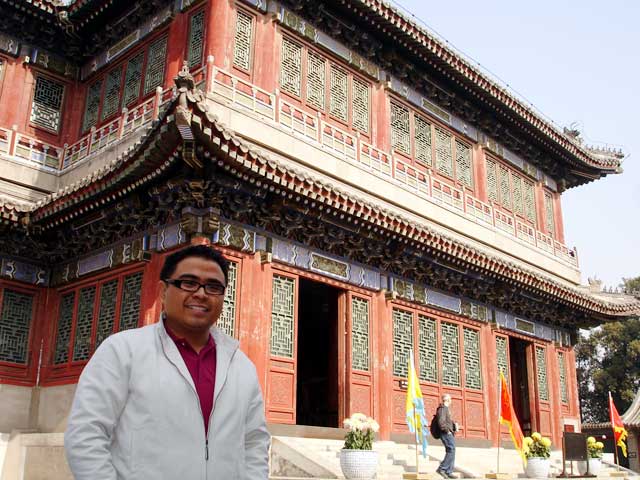
As soon as I entered, a structure covered in scaffolding welcomed me. Yikes! I hoped this was the only one being restored. It turns out it was the only one since restoration on many of the Summer Palace buildings had already been completed. I first dropped by the Garden of Virtue and Harmony which was built as a theater for Cixi. Inside is the Grand Stage (left), a three-storey theater stage which is the largest and best-preserved wooden stage in China, and is considered the "Cradle of Beijing Opera." Behind it is a two-storey make-up room which is now a showroom of Cixi's carriages and automobile, believed to be the first car imported into China.
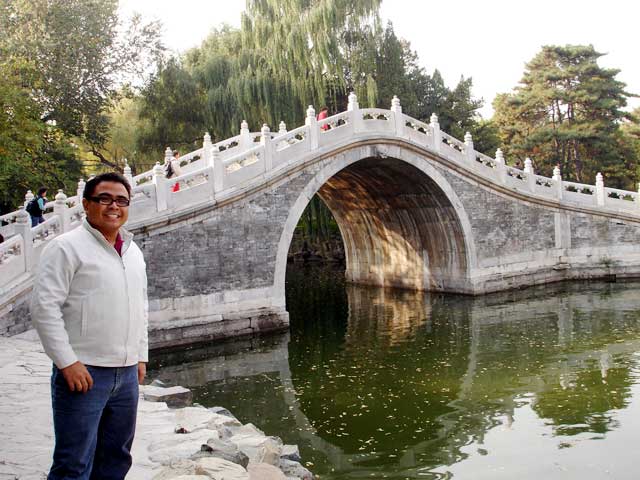
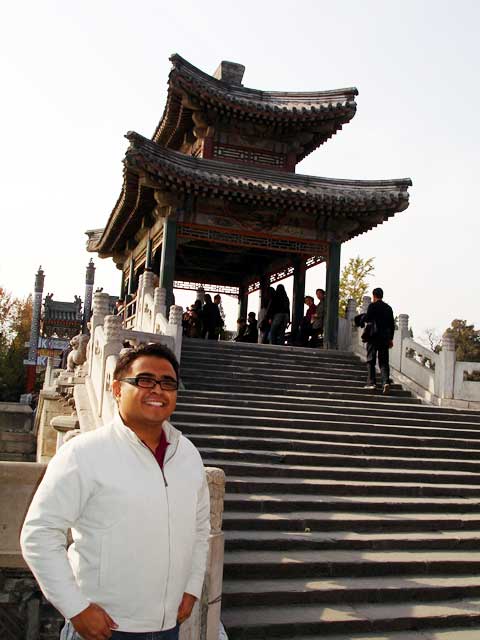
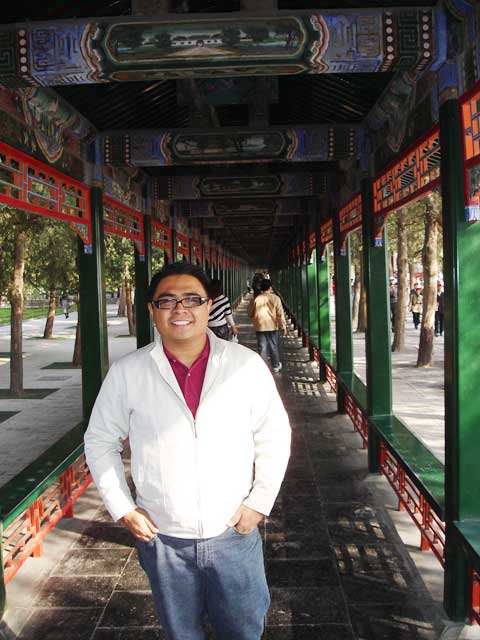
From there, I tried to walk towards the Seventeen-arch Bridge but it was quite far and I didn't have enough time. So I took a photo with Kunming Lake (昆明湖) and Longevity Hill (万寿山) as a background and then trekked towards the Tower of the Fragrance of the Buddha which was on top of the hill. Also bought some dumplings for a quick lunch. On the way to the hill, you would walk through the Long Corridor (长廊), which at 728 meters is reputedly the longest corridor in the world.
Welcoming you up the hill was the Hall that Dispels the Clouds or Paiyun Dian (left) which was built to celebrate Cixi's birthday. Inside were birthday gifts given to her by princes, dukes and high-ranking officials. I would have wanted to go up to the tower which housed a five-meter high gilded bronze statue of the Guanyin Bodhisattva cast in 1574; but time was against me. I still had a long walk and just an hour and a half left to go around. So I continued walking.
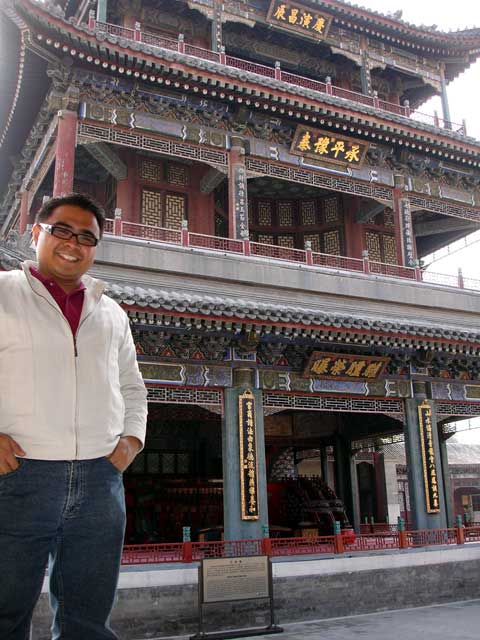
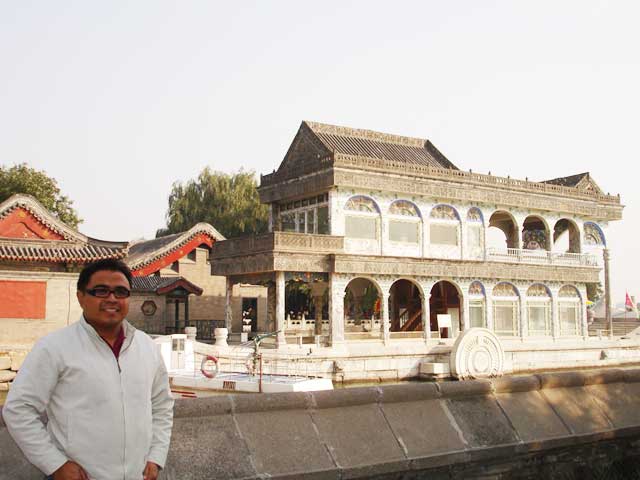
Another attraction was the famous Marble Boat (石舫) also known as the Clear and Peaceful Boat. This 36-meter two-storey boat was carved out of a shadowy blue stone. It was a symbol of stability ofthe Qing Dynasty, an idea derived from the saying "Water can carry a boat, and it can also capsize a boat," serving as a warning to the emperor that he had to attend to state affairs with prudence.
I was planning to exit via the North Palace Gate and it was still quite far. I passed by some trees which displayed autumn's colors but not as spledid as those we saw on the way to the Great Wall yesterday.
Also on the way were some nice bridges and more old structures until I finally reached the Hall of the Buddha Confirming His Docrine, a temple which housed gargantuan statues of the Buddha and various Buddhist saints.
My last stop was Suzhou Street, a famous shopping street in the imperial gardens, imitating the shops along the canal in Suzhou. It was first built in 1751 and completely destroyed in 1860. The Chinese government totally rebuilt all the structures based on photos in 1991. The street is now an impressive assemblage of old shop houses. I hope they do this as well along the canals of Binondo since we have a lot of old photos of this charming area of Manila.
I wasn't able to walk the entire area of Suzhou Street since it was already 3 p.m. and since it would take a while to get back to the city center, I decided to catch a bus. Outside was the stop for bus no. 808 which would take me to Tian'anmen Square. Again, the fare was RMB5. The trip was longer this time since traffic was heavy. The bus left at 3:30 p.m. and we were back in the city center at 5:15 p.m.
Since I didn't want to miss my train, I opted to take a cab back to the hotel to get my luggage and bring me straight to the train station. I arrived there at 6 p.m. which gave me just enough time to buy some dinner and then board the train to Shanghai. The trip was 12 hours and I was arriving in Shanghai at 7 a.m.
What I thought was Beihai Park was actually Sichahai. I think I got my directions wrong so instead of going south towards Beihai, I walked north. As I entered, a group of rickshaw drivers started to pester me. They were showing me a map and saying that it was too far to walk. And that they would take me around the sites. I pretended not to be interested and from RMB180 which is the price in the map, they offered to take me around for an hour for RMB50.
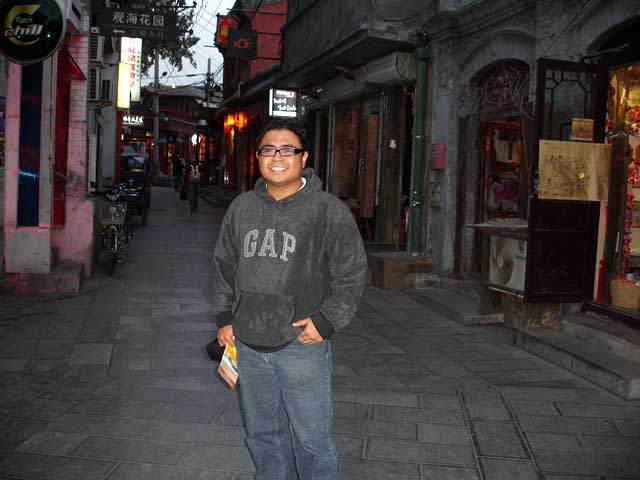
So we went around beginning in Houhai or the west bank. I did not realize it until I did some research that what I actually did was a tour of the Beijing hutongs, which are narrow maze-like lanes and alleys that were typical of Beijing communities in the olden days.
Sichahai is the lakes area north of Beihai Park. You can walk around the lakes and into some of the old hutong alleys. There are also a lot of restaurants and bars along the lakes, especially in the southern tip of Qianhai called Lotus Lane.
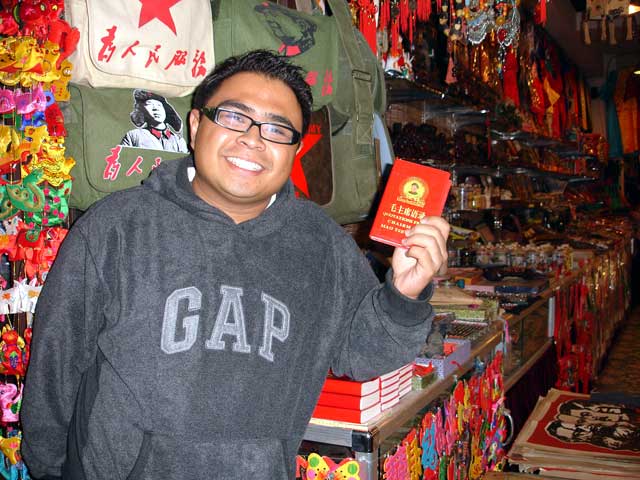
The driver took me to an alley with a lot of shops. I wasn't the one who wanted to go shopping but I just hit the tourist shop area of Beijing where in my opinion, the best Chinese souvenirs could be purchased at affordable prices, if you know how to bargain. I got myself an English version of Quotations from Chairman Mao Zedong (毛主席语录) which is known in the West as The Little Red Book. It is second only to the Bible in volume with over 900 million copies printed.
We went around more hutongs but since it was already getting dark, I wasn't able to appreciate it that much. The driver also brought me to some traditional houses which were converted into museums but I didn't want to spend for entrance which was about RMB40 each.
When the tour ended, I took a walk again in Sichahai, this time along Lotus Lane which was flooded in lights (above right). The restaurants looked very appealing but again, I was on a very tight budget so I decided to have dinner elsewhere. I saw a structure from a distance and it turned out to be the Drum Tower or Gulou. So I walked towards it.
Right beside the Drum Tower was the Bell Tower or Zhonglou (left). It was quite difficult to get a good shot of the Drum Tower in the evening since it was quite massive and there was no good angle to shoot from. But I got a photo of the Bell Tower. Hehe!
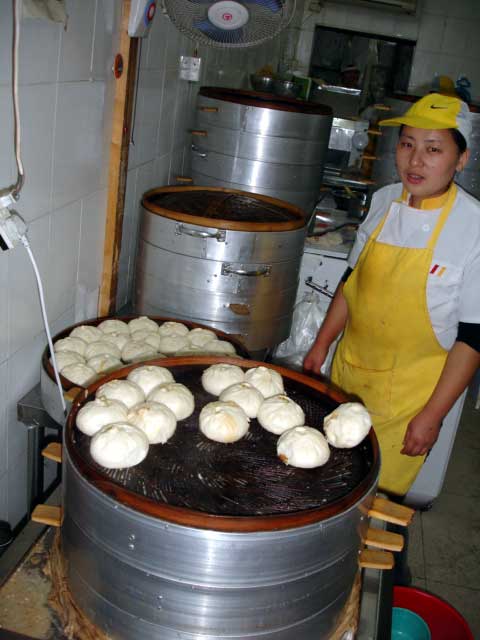
I found myself on a shopping street and decided to keep walking southwards towards the hotel. Along the way, I found dinner! It was siopao! Haha! There were different kinds such as those stuffed with pork, and the rest were stuffed with various vegetables and tofu. I don't think we have vegetable-stuffed siopao in the Philippines. The clincher here was that each piece was just RMB0.80 or roughly PHP5 each! Now that was a cheap dinner. Haha!
Since I was already tired from walking, I decided to take a taxi back to the hotel. I was already prepared to sleep when Rhea and Marlon found out about Sichahai. So I agreed to go back with them to show them the place so they could shop for more souvenirs.
While we were checking out the shops, I saw a sign which said foot massage for just RMB38. And since my feet were aching, I could not resist. When we got back to the hotel, I went straight to bed.

 I have not seen the Bagac project personally. But from several friends in the Heritage Conservation Society, I was able to get the following: there are already about eight to ten heritage houses that have been transferred to the property in Bagac, Bataan. Many of them are reportedly from Bulacan. From Pampanga, there are two namely the Reyes House from Candaba, which was said to be the oldest and one of the grandest homes in Pampanga before it was transferred, and an unidentified house from Mexico. Also purchased was the Enriquez Mansion on Hidalgo Street, Quiapo which will be transferred soon.
 It has carved stone corner pillars and carved stone garland and crucifix motifs in the entrance. The house also had peep holes for rifles to aim at tulisanes. The town thus has a different air and taking the house out would leave a large vacuum in the historical fabric of the community.