Wednesday, January 03, 2007

Singapore: A little trip around Singapore town

Wow! Talk about digging out albums from the baul! And talk about tedious too since I had to scan every photo!

I was lucky then since I still had remaining miles on my United Mileage Plus account for a free ticket to Singapore. The plan was for me to attend the 2003 SSEAYP reunion (SIGA) in April but that didn't work out since it was postponed to 2004 due to the SARS scare. So I had to rebook my ticket to a later date and I chose instead to visit when the M/S Nippon Maru was docked in Singapore and Malaysia in September. It was still risky since if the SARS situation didn't improve, SSEAYP could have been cancelled. But to make the long story short, the trip pushed through.

September 12: I arrived in Singapore late in the afternoon on a Singapore Airlines flight. I can't remember what I did that night but eating Singapore hawker food was definitely on the list. We had dinner in Holland Village if I remember it right. I stayed at the flat of my SG-mate Leon in Ang Mo Kio while in Singapore.

September 13: For lunch, I met up with the family of my mom's classmate. They took me to this great Chinese restaurant which served chili crab. In the evening, I attended the reunion on board the ship. It was great meeting old friends and munching on Nippon Maru food again.

September 14: I spent the morning walking around Chinatown. I visited the Chinatown Heritage Centre. This museum is actually several old shophouses that were refurbished to show the early days of Chinatown. In the Philippines, we now have Bahay Tsinoy.

Anyway, walking around the brightly-painted colonial shophouses in Chinatown sure shows how much Singapore loves its architectural heritage. According to one account, "Singapore's Chinatown was slated for demolition. However the government, recognizing the people's desires and the historical importance of the area, canceled plans to raze Chinatown and are now in the midst of reconstruction."


According to the Visit Singapore website, "Singapore's Chinatown evolved around 1821 when the first Chinese junk arrived from Xiamen, Fujian province in China. The passengers, all men, set up home around the south of the Singapore River which is known today as Telok Ayer. Chinatown’s local name - Niu Che Shui (Bullock Cart Water) arose from the fact each household at that time had to collect fresh water from the wells in Ann Siang Hill and Spring Street, using bullock-drawn carts.

"Not all parts of Chinatown are Chinese though. The Al Abrar Mosque along Telok Ayer Street, and the Jamae Mosque and Sri Mariamman Temple along South Bridge Road lay witness to the harmonious racial and religious atmosphere in Singapore."

Singapore has other ethinic quarters which include Little India, Geylang Serai and Kampong Glam. In the afternoon, we relaxed at the beach in East Coast Park. Located off the East Coast Parkway, the beach and landscaped terrains in the park are a weekend favorite for Singaporeans. I also got to visit CHIJMES, a heritage landmark of Singapore.

For dinner, we attended a birthday celebration and met even more PYs there. And for an evening snack, we went to Lau Pau Sat, another Singapore landmark, for some satay. Stalls open only at night when Boon Tat Street is closed from vehicular traffic since the stalls and tables occupy the street.

September 15: Lunch was with my SSEAYP host sister. The highlight of the day was a boat trip along the Singapore River. I paid SG$12 for the guided tour. It came with a great map which showed the highlights of Singapore River, from the restored shophouses and imposing colonial structures, the many charming bridges, to modern-day skyscrapers.

Of course, you couldn't miss the Merlion. A half-fish, half-lion beast, it is a fitting symbol of Singapore. The singa or lion is said to represent the animal that a Sumatran prince saw when he rediscovered Singapore while the fish is a tribute to Singapore's history as Temasek, the ancient sea town.

After the brief tour, I strolled around Boat Quay and Clarke Quay. Now that is adaptive reuse! The old shophouses and warehouses in the area were restored and converted to chic bars and restaurants which come alive especially in the evenings. If Mayor Atienza had some political will and love for heritage, he could do this rehabilitation and urban renewal in San Nicolas for example.

For the evening, it was a visit to largest fountain in the world at Suntec City. Made of cast bronze, it was built in 1997 costing an estimated US$6 million.

September 16: Traveling to Malaysia from Singapore is very easy since you can do it by land. I took a six-hour bus to Kuala Lumpur for SG$25. I was met at the Puduraya Bus Station by another SSEAYP batchmate and we had dinner for a while at KFC. But I was leaving for Penang on an 11:59 p.m. bus so not much time to chat.

Check out this song called
Singapore Town.

Heritage watch
More endangered fish found inside boat of arrested Chinese

Tuesday, January 02, 2007

Looking back at SSEAYP 2002

Happy New Year to all! Time really does fly fast and I can't believe it's already 2007! Anyway, I was cleaning my room a few days ago and I got to look at some albums from previous trips when film cameras were still in style.

After my voyage on the Ship for Southeast Asian Youth Program in 2002, I tried my best to visit my friends in the various ASEAN countries every year. I remember in 2003, my trip was postponed several times due to SARS. It finally pushed through in September and it was a blessing in disguise since it coincided with the docking of the M/S Nippon Maru in Singapore and Malaysia. In 2004, I went to Hue, Vietnam but wasn't able to meet up with anyone. My mistake was I sent the e-mail message too close to the trip and my SG-mate (the 340 participants are divided into 11 Solidarity Groups or SGs) only found out we were in the same city, attending the same festival when we got back.

My blog was born during my trip in 2005 to Kota Kinabalu, Malaysia and Brunei. The very first post was actually in my Friendster blog which is still up and about. In April last year, I made a whirlwind tour around Southeast Asia visiting five countries namely Malaysia, Singapore, Cambodia, Thailand and Laos. I've blogged about all these post-SSEAYP trips already except the one in 2003. And thinking about it, I may never get to see again some of the cities I visited during that trip. It would be a pity if I didn't write about them, two of which are heritage towns of Malaysia namely Penang and Malacca. So for the next few days, I'll be looking back and writing about that trip.

Heritage watch
Enriquez antique mansion goes kaput
Yes people! The Enriquez Mansion along Calle Hidalgo, an 1890s house with Ionic columns and praised by Maria Morilla Norton in 1910 as the "the most beautiful house in the islands," the same one which became the site of the School of Fine Arts of the U.P., is now Acuzar property and has been transferred to Bagac, Bataan. And yes, Acuzar is planning to build a 20-storey building to replace this elegant house in the heritage street.

Saturday, December 30, 2006

Happy Rizal Day!

The networks will definitely be congested beginning tomorrow. Besides, it would be more meaningful to greet people today. So to all my friends... Happy Rizal Day! May Rizal's martyrdom remind us to love our country and be proud to be Filipinos!

Here are some of the lesser known quotations from Rizal's writings:
"They could serve the country more if they were in the Philippines. To serve our country, there is nothing like staying in it. It is there that we have to educate the people, it is there that we have to work." - Letter to Jose M. Basa, January 1889

"A nation wins respect not by covering up abuses, but by punishing them and condemning them." - The Philippines a Century Hence, La Solidaridad, 15 December 1889

"People and government are correlated and complementary. A stupid government is an anomaly among a righteous people, just as a corrupt people cannot exist under just rulers and wise laws. Like people, like government, we will say, paraphrasing a popular adage." - The Indolence of the Filipinos, La Solidaridad, 15 September 1890

Rizal in the news
Rizal joins ranks of Dickens, Austen
"JOSE Rizal’s 'Noli Me Tangere' has been published in a new English translation and released worldwide by Penguin Books, one of the major publishing houses of the English-speaking world, under the Penguin Classics imprint. The publication effectively canonizes the novel as one of the classics of world literature." All I can say is... wow!
National hero a prisoner of myths
This article by Ambeth Ocampo talks about and debunks urban legends on Rizal, such as the one which says he was the father of Adolf Hitler, and another that he was Jack the Ripper! Talk about imaginations running wild!

Heritage watch
China urged to stay away from case of Chinese ‘poachers’

Congress urged to probe poaching in Tubbataha Marine Park

I knew something like this was going to happen. It's a good thing the local provincial and church leaders as well as environment stakeholders in Palawan are not letting down their guard.

Friday, December 29, 2006

Manila: Inside, outside and on the walls

Today, we did a walking tour of Manila's San Nicolas and Intramuros areas. Since Manila Streetwalker Ivan ManDy was free that afternoon, he took me, Karlo and Maricris around Binondo and San Nicolas. But before that, how could we resist not eating in Chinatown? So lunch was first on the agenda.

My tokayo brought us to Benavides Street which is fast transforming itself into a restaurant row. Lunch was at the Hiongso Chicken Restaurant which we were told was value for our money. And my tokayo was indeed right because we had a big bowl of hot and sour soup (they say it's good for three to four people, but this is the size they serve at Chinese restaurants for ten people!), honeyed pork spareribs, peppered beef tenderloin and Yangchow fried rice all for PHP430. That's about PHP100 for each of us and we were so full!

After that, it was time for the walk around San Nicolas. As Ivan ManDy writes, "In San Nicolas we have what is probally Manila's single largest concentration of period houses and mind you, not the 'old-new' (bagong-luma) wannabe architecture that characterizes much of Intramuros. This is as true as it can get.

"On a personal note, I can honestly say this district is special, not just for every true-blue, heritage-loving Manileño but personally for this walker who, as a child, spent his early years amidst these beautiful wooden houses, playing on the very streets while sucking in the atmosphere of commerce, dark esteros and the overpowering smell of onions.

"These days, the historic properties are still there. Though diminished substantially, they still provide a backdrop of what old Manila looked, felt and smelled like in the days of our ancestors. What revolutions, earthquakes and a world war didnt destroy, our 21st century cavalier attitude eventually will. It's a conststant battle between the old and new, commerce and culture, development and destruction, why can't we get these acts together?"

Yes, it was one of the few Manila districts which survived the Second World War. But we are fast losing it. In fact, Ivan said that twenty years ago, San Nicolas was even more grand and a lot was lost since then. Another avid traveler, Sidney Snoeck, rated his visit to San Nicolas a 10 out of 10. He says, "Even if they are in a far state of decay those 19th century old houses have still a lot of charm. I saw a lot of lovely windows, doorways and panels decorated with stars & flowers."

"This district has probably the biggest collection of 19th-century houses that still exist in Manila," Sidney writes. "It seems that those houses are just waiting to be demolished. Actually I saw quite a lot of new buildings being constructed. It is too bad that the owners of those marvellous houses don’t have the money to renovate them. My advice is to visit this neighbourhood as soon as possible and take a lot of pictures. I fear that in ten years time the whole neighbourhood might be just another concrete jungle. I feel bad because I know it will not be saved for future generations. Sad, very sad," he adds.

If only our local officials could see the potential of the heritage architecture in this area when rehabilitated properly. Living in these grand and charming old houses were actually informal settlers. So much potential when only if Manila's policy-makers were forward looking! The Manila districts outside the walls are still worth saving.

From there, we trooped to Intramuros to check out the books at Tradewinds. At 5 p.m., Ivan calls us to let us know he was free to join us at Intramuros. So we went to the Baluarte de San Diego area. Believe it or not, it was the first time I actually walked on the walls. To find out where that is, check out this Intramuros Virtual Map.

According to Jose Victor Z. Torres in his book Ciudad Murada: A Walk through Historic Intramuros, "There were seven gates in Intramuros (not including Fort Santiago): Postigo, Santa Lucia, Real, Parian, Isabel II, Santo Domingo, and Almacenes."

"The city had 32 streets: Aduana, Almacenes, Anda, Arzobispo, Audiencia (now part of Gen. Luna), Basco, Beaterio, Cabildo, Claveria, Escuela, Hospital (now part of Cabildo), Legazpi, Maestranza (disappeared after this section of the walls was demolished), Magallanes, Muralla, Novales, Postigo, Real del Palacio (now Gen. Luna), Real, Recolletos, San Agustin, San Francisco, San Jose, San Juan de Dios, San Juan de Letran, Santa Clara, Santa Lucia, Santa Potenciana, Santo Tomas, Solana, Urdaneta, and Victoria.

"Intramuros had nine bastions: Baluarte de San Miguel, Medio Baluarte de San Francisco, Baluartacillo de San Francisco Javier, Baluarte Plano Luneta de Santa Isabel, Baluarte de San Diego, Baluarte de San Andres, Baluarte de San Francisco de Dilao, Baluarte de San Gabriel and Baluarte de Santo Domingo as well as small fortifications like Revellin del Parian, Revellin de Real de Bagumbayan, Revellin de Recolletos and redoubts like Reducto de San Pedro and Reducto de San Francisco.

"Within the city there were seven churches: Manila Cathedral, San Agustin, Lourdes Church, San Ignacio, San Francisco, Santo Domingo and Recoletos..."

As Ambeth Ocampo writes, "The above shopping list ends with hospitals and schools. Just reading it makes one imagine Intramuros at its height, before the Americans destroyed it during the Battle for Manila in 1945."

We actually went up through the Baluarte de San Andres since the guards wouldn't let us in at San Diego since a wedding reception was on-going. From San Andres, we were rewarded with great views of Manila's American colonial architecture from the Central Post Office, Manila City Hall, the former Legislative Building and Finance Buildings (now the National Museum), and the Department of Tourism. It was obvious what big idiots we have in the Manila City Hall since they allowed several buildings behind it to rise higher than the charming city hall building itself, ruining what would have been a grand and elegant vista.

Anyway, it was fun watching the sunset and we walked the walls back to San Diego, sneaked past the guards and exited through the entrance the guards didn't want to let us through. Hehe! I'll try to do that again some other time, this time walking the entire length of the fortifications of the walled-city!

Save Corregidor!
There was this e-mail message circulating about something happening in Corregidor. I didn't want to react to it immediately since I knew the people who were involved and wanted to ask for their side first before I made any shout-outs. It turns out, the e-mail message was one-sided and the only thing that was true about it was the fact that the government is not giving any attention to Corregidor!

Leslie Murray af the Filipino American Memorial Endowment writes, "Amazing how UNESCO can save the terraces and the churches, and here we have vestiges of one of the most famous chapters in recent history on the doorstep that could bring in a whole niche market of visitors (WWII survivors' and fatalities' families, historians, etc.) to a site that really turned the tide of that war. And nobody, until now, has seemed to care."

Indeed, we are wasting the potential of this island. In fact, I think the World War II Memorials of Bataan and Corregidor should be nominated to the UNESCO World Heritage List. The A-Dome in Hiroshima is in the list already.

Heritage watch
Finding the past in Alegria
A bridge breathes its last
Now this is totally stupid! The article says: "Alegria used to be the only town in Cebu that had two bridges figuratively spanning the colonial period. One was the remnant of the only Spanish-era arched stone bridge in Cebu, the other a 1913 bridge built probably built by the famous American colonial engineer Eusebius J. Halsema when he was public works chief in Cebu.

"Both are long gone now as they were torn down without much ceremony by a conservation-deficit contractor three months ago. Vice-Mayor Verna Magallon, chair of the local Tourism and Heritage Council, fired off protest letters as a result but these were for naught. When we met her for lunch last week, she told us that the Sangguaning Bayan invited the contractor twice in order to learn about its plans. But the contractor never showed up and the bridges are now nowhere to be found." That contractor is one big idiot!

Thanks to Manila Streetwalker Ivan ManDy for photos of San Nicolas and to Karlo de Leon for taking our photos in Intramuros.

Wednesday, December 27, 2006

Manila: Battle for Manila

As I've mentioned time and time again, Manila was devastated during the Second World War. Thus, with so much lost, the architectural heritage left standing today should be preserved for future generations of Filipinos. Just to give you an idea of the destruction, check out this 1945 footage of the only urban battle in the Pacific, where Manila was flattened to the ground. Today we wage a battle to preserve Manila's heritage!


Thanks to Hawayano of SkyscraperCity for uploading it on YouTube!

Heritage watch
Sino poachers caught with endangered fish in Tubbataha

BFAR to escort Chinese vessel out of Tubbataha?
Kudos to the Tubbataha Management Office for enforcing national and international laws with the arrest of poachers in the protected reef. Let's just hope no government official will throw his weight around and intervene for the fishermen and vessel owner.
Baguio City starts 1,000-day countdown to 2009 centennial
Now this is good news for Baguio City! The organizing committee has "decided to celebrate Baguio’s centennial as a three-year continuing advocacy for policies that would protect its American and Ibaloi heritage."
Facelift for Taguig lakeshore
This is great news for Taguig City if they are able to revive the old town district! It's good to hear that the legendary Napindan Lighthouse is finally getting the attention it deserves. Wow! That's a lot of good news for Philippine heritage today!

More from Ligligan Parul
While doing my rounds of YouTube, I found a video of the giant lantern of Barangay San Felipe, this year's champion. It was only now that I was able to review their first round routine and was impressed even more since the interplay of lights was simply exciting. Notice that they use the traditional marching band music. I'm going to get footage of the first round routines of the three winners from InfoMax8 so watch out for it. Anyway, here is the video.

Monday, December 25, 2006

Merry Christmas to all!

Aklanon - Malipayon nga Paskwa ag Mahigugmaon nga Bag-ong Dag-on!
Asi - Maadong Santos Paskwa ag Masadyang Bag-ong Tuig!
Ata - Maroyan na Pasko woy Kaopia-an ng Bag-ong Tuig kaniyo't langon mga sulod
Bikol - Maogmang Capascuhan asin Mamura-way na Ba-gong Taon sa indo gabos!
Blaan - Pye duh di kaut Kristo klu munt ug Felemi Fali!
Binubolinao - Marigan Nabidad
Boholano - Malipajong Pasko ug Maajong Bag-ong Tuig

Cebuano - Maayong Pasko ug Bulahang Bag-ong Tuig!
Chavacano - Felices Pascuas y Prospero Año Nuevo con todos!
Dibabawon - Marayaw na Pasko aw Bag-ong Tuig kaniyo tibo na mga soon!
Gaddang - Mangamgam Bawa a dawun sikua diaw amin
Hiligaynon - Malipayon nga Paskua kag Malipayon Nga Bag-ong tuig!
Hungduan - Maphon au nitungawan. Apo Dios Kituwen baron di toon
Ibanag - Mapalupaguiya nga Pascua
Ibaloi - Eshadsak ja Paskua! Eshadsak ja Badon Tawen!
Ifugao - Malinggop an Baro an Tawon
Ilocano - Naimbag a Pascua ken Naragsac nga Baro nga Tawen!
Kankanaey - Gawis ay Paskua ya Nalagsak ay Balo ay Tu-en!
Kapampangan - Masayang Pascu ampong Masaplalang Bayung Banua kekayu ngan!
Mandobo - Mepiya Pagasaulog sa pagka-otawni Jesus aw maontong kaling Omay!
Mangyan Buhid - Fiya Pagpasko
Mangyan Hanunuo - Mayad paq Pasko
Mansaka - Madyaw na Pasko aw malipayong Bag-ong Tuig kamayo, mga lumon!
Masbatenyo - Malipayon nga Paskwa
Onhan - Mayad nga Paskwa kag Masadya nga Bag-ong Tuig!
Pangasinan - Maabig ya Pasko! Maliket ya Balon Taon!
Romblomanon - Malipayon nga Paskwa kag Masadya na Bag-ong Tuig!
Sambal - Maligayang Pasko at Masayang Ba-yon Taon!
Subanen - Piak Pasko pu Piag Bago Tawn!
Surigaonon - Malipayon na Pasko sanan Bag-on Tuig!
Tagakaolo - Madyaw Pagsalog sa Pagka-otaw ni Jesus
Tagalog - Maligayang Pasko at Manigong Bagong Taon!
Tala-andig - Maayad ha Pasko daw Bag-ong Tuig!
Waray-waray - Maupay nga Pasko ngan Mainuswagon nga Bag-o nga Tuig!

...wishing for a united Filipino nation this Christmas!

Heritage watch
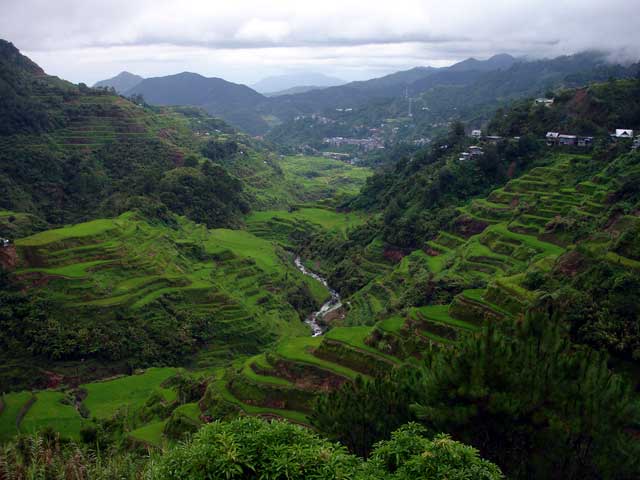
The lack of funds is hampering efforts to restore our world famous rice terraces. Check out the PDI article here. According to the article, "the (UNESCO) team 'noted with concern' that little progress was made to implement the recommendation of two teams that visited the terraces in September 2001 and June 2005 that called for the preparation of a comprehensive conservation and management plan for the terraces.


"The teams also asked for the allocation of steady funds to address the challenges, to be drawn from the conservation plan.
"Unesco said the 'corrective' measures on the rice terraces must be ready by the end of 2007 as a condition for the removal of the terraces from the list of endangered world heritage sites."
It adds, "Unesco earlier included these terraces in the endangered list after its inspection teams found out that the terraces have deteriorated due to uncontrolled construction of houses, erosion induced by climate and abandonment of the terraces by the farmers."

Imagine, the government is proposing a PHP1.29 trillion budget and yet it spent less than PHP1 million for the Ifugao Rice Terraces, a national cultural treasure and UNESCO World Heritage Site. I hope the NCCA speeds up the release of the PHP50 million rehabilitation fund. And even better, I hope Congress increases the budget for the restoration of our heritage!

Friday, December 22, 2006

Heritage updates

Heritage bills in the Senate
The Sub-committee on Education, Arts and Culture created a Technical Working Group (TWG) tasked to do the following:
1. Prepare a draft bill that will integrate and harmonize the essential elements of a National Heritage Protection measure from pending bills before the Committee on National Heritage;
2. Request additional position papers from various stakeholders, including but not limited to, artists and conservation architects, archaeologists and biologists, conservationists, historians and Muslim and ethnography scholars;
3. Review all the existing laws, presidential decrees and treaties with regard to protection and conservation of Historical, Natural and Cultural Heritage in order to have a systematic body of conservation laws.

The Heritage Conservation Society is among the members of the TWG. It is in this regard that we would like to ask for position papers on the said Heritage Bill. Please send them to hcs_secretariat@yahoo.com. Thanks!

Heritage watch
Iloilo plaza can’t be altered without NHI green light

Heritage conservation awards
I just received a call for nominations for the 2007 UNESCO Asia-Pacific Heritage Awards for Culture Heritage Conservation. The awards were established "to recognize the achievement of individuals and organizations within the private sector, and the public-private initiatives, in successfully restoring structures of heritage value in the region."

To be nominated, the restored structure must be at least 50 years old; privately owned or leased; restoration must be the result of private initiative or a public-private partnership; and restoration must have been undertaken within the last ten years and put into viable use for at least one year prior to the award.

We were thinking of nominating the restored Gabaldon buildings under the Heritage Schoolhouse Restoration Program of the DepEd and HCS but since it is financed and owned wholly by government, they are not eligible for nomination. You might know of conservation on other structures which deserve to be recognized. Deadline for nomination in March 31, 2007. Visit http://www.unescobkk.org/index.php?id=480 for more details.

We've won three Honourable Mention honors namely Nielson Tower, which is now the Filipinas Heritage Library in 2001; Gota de Leche Building in 2003, and the Far Eastern University Manila Campus in 2005. Other nominees were the Balay Negrense Lifestyle Museum - Don Victor Gaston Y Fernandez Ancestral Home, Silay City; Fule-Malvar Mansion, San Pablo City; Orchid Garden Suites, Manila; Zaragoza Mansion, Vigan; General Emilio Aguinaldo Shrine, Kawit, Cavite; Syquia Mansion, Vigan, IIocos Sur; and the Santos-Andres House, Antipolo City.

Grants deadline nearing
Just to remind everyone, the deadline for nominations to the World Monuments Watch for 2008 is on January 15, 2007. Announced every two years, the World Monuments Watch list of 100 Most Endangered Sites calls international attention to cultural heritage sites around the world threatened by neglect, vandalism, armed conflict, or natural disaster. It fosters community support for the protection of endangered sites and attracts technical and financial resources to assist in their rescue. More than 75 percent of the sites have been saved or are well on their way, thanks to timely intervention. To download the nomination form, click here.

Tuesday, December 19, 2006

Manila: Old street excavated in Plaza Cervantes

Wow! I was just talking about the walking street in Guangzhou, China (left) where they accidentally discovered several layers of older streets while excavating for a redevelopment project. The nice thing about it was that they covered it with glass. And it is now an attraction of the walking street.

Well, they just discovered an old street in the old business district of Binondo! I first heard about it at the Senate hearing on the heritage bills yesterday morning. But like most heritage sites in Manila, I was already resigned to its obvious fate. Which is why I was pleasantly surprised when I read the short article below in the Philippine Star. In fact, I'm still in a state of shock! Has Mayor Lito Atienza finally seen the light? What do you think?

Atienza orders artifacts secured
The Philippine Star 12/19/2006


Manila Mayor Lito Atienza has ordered Plaza Cervantes in Binondo secured following the discovery of what appeared to be centuries-old artifacts dating back to the Spanish era.


A pipe-laying crew of Maynilad Water dug up a portion of what appeared to be a cobblestone street several days ago.

Atienza instructed City Engineer Armand Andres and Museo ng Maynila officer-in-charge Monina Santiago to coordinate with the National Historical Institute "to ensure that not a single piece of what would be a precious legacy is damaged or pilfered."

Binondo was Manila’s main business district during the Spanish colonial era.

Related articles
Binondo artifacts safe
Artifacts' preservation sought in city ordinance
Related Posts with Thumbnails